

Wildlife Connections
‘…no-matter what sort of animal, bird or snake…
all that animal same like us.
Our friend that.’
Bill Neidjie, Gaagudju Elder, Kakadu.
The term ‘wildlife’ includes the thousands of insects (over 500,000 species), spiders (850 species), invertebrate animals (300,000 species) and of course the more visible and iconic mammals (379 species), reptiles (860 species) and of course the frogs (214 species) and of course birds (898 species). Because birds are so diverse and play such an essential part in my world as a publisher, artist and naturalist, I have presented them as a separate collection.
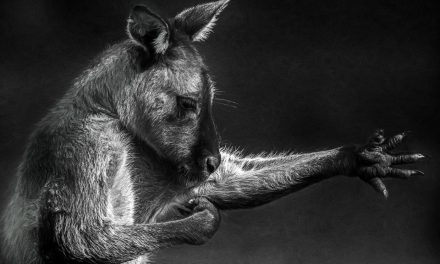
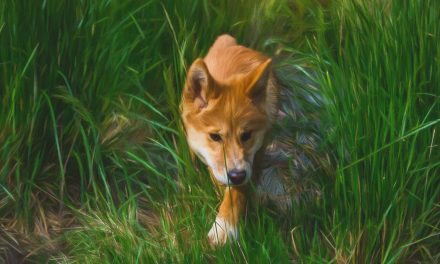
What makes this wildlife collection unique is that it features the more iconic mammals, creatures which have been a focus of my work for many decades. Macropods (kangaroos and wallabies), along with the apex predator the dingo, and some of the more iconic reptiles are features of this collection. While I am driven to discover and share the natural histories of our wild creatures, this collection has more to do with my emotional connection. Not just for me but for the many thousands of Australians who care deeply about the conservation of these precious wild creatures.

Comfort Zone
Every day of their lives numbats leave the safety of their tree hollow nests to venture out into an unsafe world to feed. Here the animal is frozen midstep as it uses all senses to search out potential danger. The Numbat is the wildlife emblem of Western Australia, and they are a specialist termite eater, using its strong olfactory sense to sniff out termite mounds and devour the insects within by flicking out its extremely long tongue. Like many of Australia’s mammals, the Numbat’s distribution has decreased significantly since the European occupation of Australia.

The Runner
The Bare-nosed wombat lives in heathlands and woodlands scattered across south-eastern Australia. A close relative of the wombat, these generally shy nocturnal warren-dwellers and extremely adept at digging. They breed every two years and produce a single joey which, like their marsupial relatives, is carried in a backwards facing pouch; ideal for digging

Gem Of The Forest I
Secretive in nature, the green tree python is undoubtedly one of the most spectacular snakes in Australia. They are harmless and restricted to Cape York rainforests.

Caring for Puggle
A female Echidna cares for its single baby, known as a puggle. With many enemies close by the mother tucks her single young away in as safe a hide-a-way as she can find, in this case a hollow log.

Engaging Connections
The spectacled flying fox is a megabat that lives in Australia’s north-eastern regions of Queensland.
They are important seed dispersal animals for rainforest trees and are known to help spread the seeds of about 26 species. Day roosting camps comprise thousands of individuals in mangroves and rainforests, but they fly out in pairs to feed at dusk.
Spectacled flying foxes are among the most engaging wild creatures I have ever encountered. Recently, I enjoyed an extended period working with over fifty of our eighty plus bat species and it was this experience that created a life-long connection and motivated me to work at communicating an appreciation of these intelligent creatures to the broader community.

The Charesmatic Quoll
This efficient predator is the largest carnivorous marsupial on the Australian mainland. Its range has been dramatically decreased, although sporadic sightings have been made in parts of its prior range. It is a savage hunter of other, slightly smaller mammals and feeds on carrion and invertebrates. Spotted-tailed Quolls are partly arboreal and are agile climbers but spend most of their time on the ground. Although nocturnal, they are sometimes seen basking or hunting by day. Usually inhabit dens in hollow logs, caves or rock crevices in heavily forested country..

Tree-to-tree II
While koalas are iconized as tree dwellers, they do visit the groud to move tree to tree within their territory.

Moloch Celebration
This small, slow-moving and quite gentle ant-eating reptile has an extraordinary natural history and each time I encounter one in the desert my heart skips a beat. Their form, texture and body patterns create unrivaled camouflage and their genetic name, Moloch, goes back to 500BC into Babylonian times. Like many Australian reptiles, they are endemic.


Hello Sales,
Am Ben Murphy,am emailing you to let you know that am interested in purchasing some items in your store and let me know if you can ship to Malta and my means of payment is Credit Card payment.Also i have a freight forwarder that will come for the pickup of the items.kindly email me back so that i can let you know the items i needed.
Hi Ben, I am responding via email direct to your email address.