
Red Land Blue Sky
‘When I am…completely myself, entirely alone…
it is on such occasions that my ideas flow best and most abundantly.’
Wolfgang Amadeus Mozart, composer
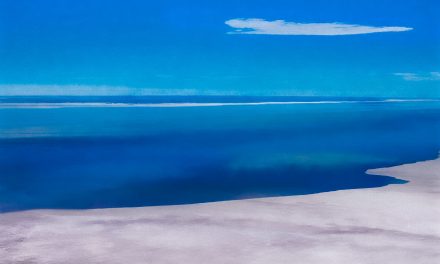
Australia is the driest inhabited continent, with 70% of its land being either arid or semi-arid. Arid areas receive an average rainfall of 250mm or less. The vibrant hues of the landscape, from cool blues and warm yellows to pinks, grays, and fiery reds, can be intense and captivating, particularly as the sun moves across the sky. Despite its harshness for human habitation, wide-open spaces can evoke strong emotions from an aesthetic standpoint.
For many people, the appeal of arid lands lies in their colors and textures, which are especially pronounced when viewed from an altitude of 1,500 to 3,000 meters. This vast canvas can be incredibly alluring.
As time passes, we often start noticing things we might have missed, such as seeing, hearing, smelling, and feeling. This increased awareness can lead to a deeper appreciation of our surroundings, and thinking becomes more focused and inspiring. The challenge is maintaining this clarity and preventing distractions from creeping back in when we return to our familiar environment. Being alone in the wilderness allows our senses to relax and can stimulate creative thinking.
Regarding artistic credit, I often reflect that the wind, water, and countless years deserve recognition for creating these stunningly beautiful landscapes.

A Sense Of Presence
More than any landscape formation I have experienced the domed ranges of Kata Tjuta have that very special spiritual presence. A spiritual connection, of course, is a living part of the local indigenous culture and all who enter respect that fact. However, this ‘sense of presence’ is what I believe draws so many thousands from across the planet to walk its valleys and to sit and marvel as the dawn and dusk slight paints its ruby hills with astounding colour.
People need and must connect with wild places, and this is a very special wild place indeed. Kata Tjuta, Uluru-Kata Tjuta National Park, Northern Territory.

One Thousand Blessings
Budgerigar flock, western Queensland

In the Stillness
It was the stillness and solitude of the moment – enhanced no doubt by the wild-space that inspired me to create this image of a solitary tree standing alone in a harsh yet graphically beautiful landscape.
East MacDonnell Ranges, Northern Territory – a wild place that commands one to stop, look and listen.

Karajini Billabong
A ghost gum lined billabong at sunrise, as exciting a a child’s first visit to a candy store. Karijini National Park is a vast wilderness area in the Hamersley Range of Western Australia.

Stillness and Solitude
Finke River, West MacDonnell Ranges. The Finke River is one of the world’s oldest rivers.

Bungle Bungle Range
The Bungle Bungle Range is the landform that is the major component of the Purnululu National Park situated in the Kimberley region of Western Australia. The distinctive beehive-shaped towers are made up of sandstones and conglomerates (rocks composed mainly of pebbles and boulders and cemented together by finer material). These sedimentary formations were deposited into the Red Basin 375 to 350 million years ago when active faults were altering the landscape. The combined effects of wind from the Tanami Desert and rainfall over millions of years shaped the domes. Weathering also helped create this marvel. Water seeps into the rock, and at night it expands as it gets colder. This creates small cracks which eventually wears out the rock.

A Natural High
When a series of dramatic natural elements combine we photographers experience our endorphin-filled creative highs. This beautiful – a grass tree, that belongs to Xanthorrhoea a genus of about 30 species of related flowering plants endemic to Australia, has been on my radar for decades. Some time back I decided to ‘stalk’ the tree planning to arrive at first light each day hoping for a dramatic capture. As has been quite fortunate throughout my comings and goings across Australia the very first attempt produced this spectacular combination of sunrise and cloud formation. Ah, sweet bliss! Ikara-Flinders Ranges National Park, South Australia.

Distant Ranges
Giant river gums, distant multicoloured-ranges, a wonderfully iconic image of Australia. Ikara- Flinders Ranges National Park, South Australia.

Razorback Road
View from Razorback Lookout Ikara-Flinders Ranges National Park, South Australia.

Misty Morning
A soft, rainy morning at Ikara-Flinders Ranges National Park, South Australia.


Adnyamathanha Country II – Arrernte Country
Above: ‘Adnyamathanha Country II’ – Vulkathunha-Gammon Ranges National Park, South Australia.’
Below: ‘Arrernte Country’ – Simpsons Gap (Arrernte: Rungutjirpa) is one of the gaps in the West MacDonnell Ranges Tjoritja/West MacDonnell National Park, Northern Territory. .


Karlu-Karlu – Imarnte Country I
Left: ‘Karlu-Karlu’ – Karlu-Karlu/Devils Marbles Conservation Reserve Northern Territory.
Right: ‘Imarnte Country I’ – Looking eastward and in the stillness of the golden afternoon light a replica of the iconic massif of Rainbow Valley appears reflected in a flood-filled claypan. Rainbow Valley Conservation Reserve is a protected area located south of Alice Springs, Northern Territory in Australia established to protect the unique sandstone formations and the Aboriginal art, artefacts and sacred natural objects around a large sandstone bluff.
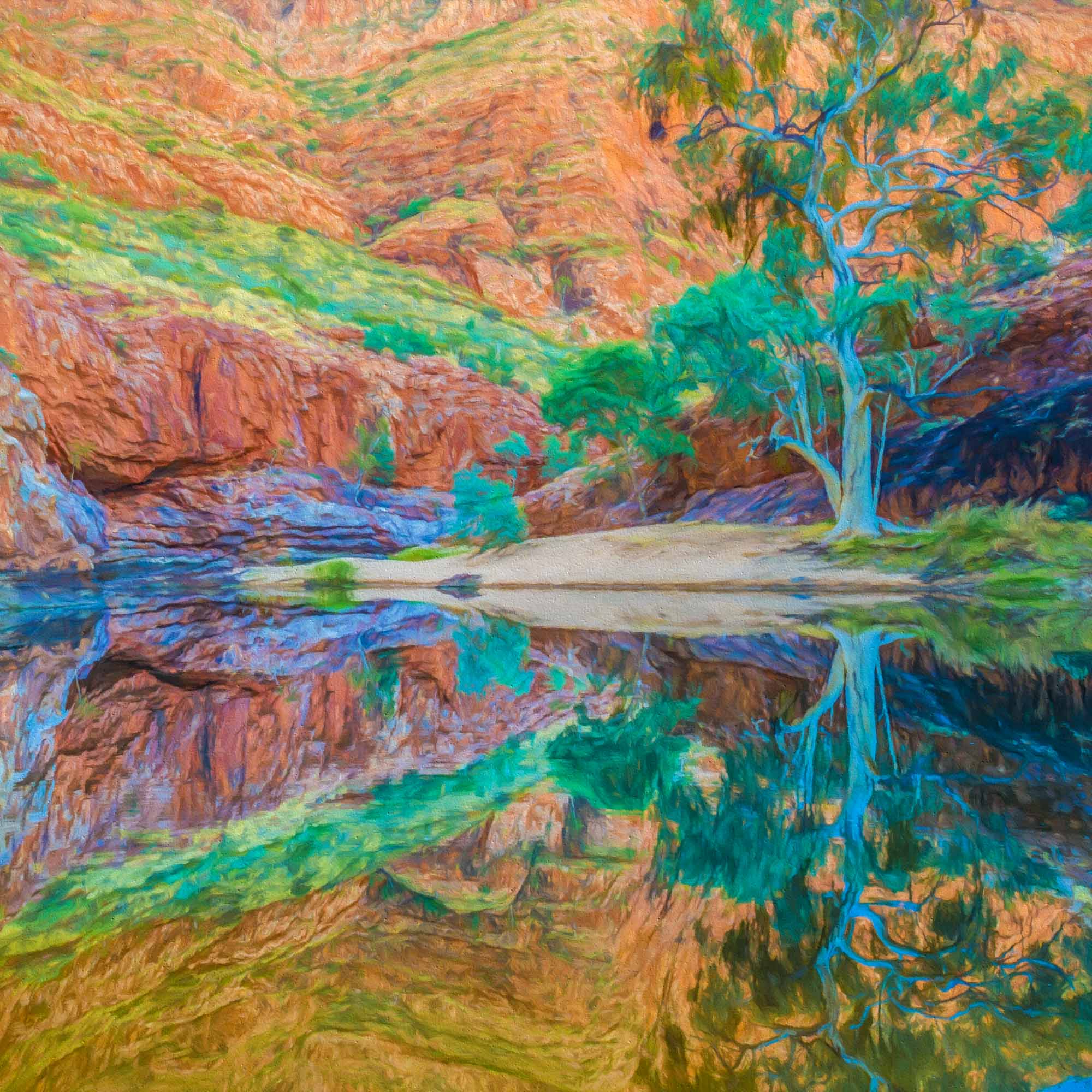
Watercolour Wonderland
The cooing of pigeons, the thumping of rock wallabies, rustling leaves, buzzing flies, the smell of decaying vegetation and the sense of wet sand between your toes, these are the ingredients that add a background theatre to this visual delight. This image is a blend of the juncture between an age-old water-worn gorge, that took nature aeons to create, and the spirit of a human immersed in pools of reflection. Ormiston Gorge, Tjoritja/West MacDonnell National Park, Northern Territory.