Kati Thanda – Lake Eyre
‘Seek out the essence of your joy,
then honour it with full attention.’
Steve Parish
As a photographer, I’m often torn between realism and abstraction. Thirty hours airborne from William Creek during a period of flooding stands as the pinnacle of my career photographing Australia, both from above and below. Looking vertically from 10,000 feet, I witnessed a mesmerising collage of shape, shadow, colour, and texture that deepened my lifelong love affair with the art of land. I was so overwhelmed by the beauty that tears flowed freely—I was photographing through blurred vision, utterly entranced.
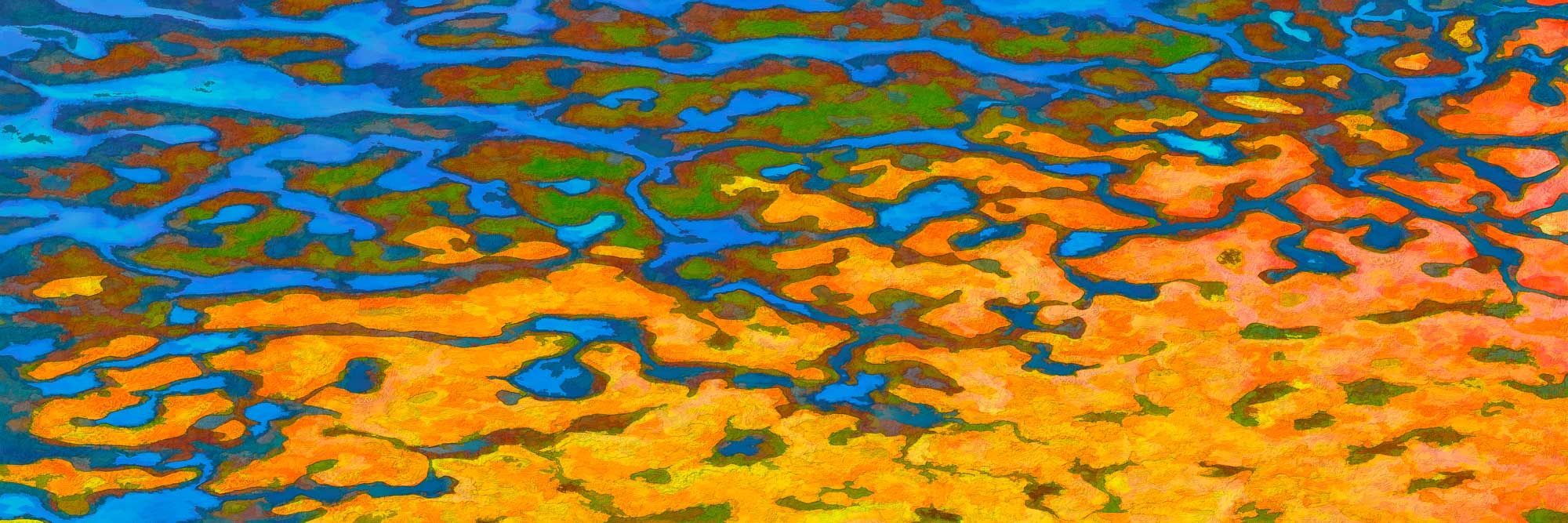
Some landscapes, like the one featured above, resembled vast, living mazes—myriad minor creeks weaving toward the lowest point, ultimately becoming ‘as one.’ It struck me as a powerful metaphor: a river of consciousness. People begin as individuals, flowing in different directions, eventually converging, forming a single, unstoppable force. In nature, these tributaries become Warburton Creek, which winds 400 kilometres to bring life to Lake Eyre.
The transformation water brings to this arid land is one of the most awe-inspiring natural events I’ve ever witnessed. Kati Thanda–Lake Eyre National Park protects these desert expanses, including the nation’s largest salt lake and its lowest point. When I first visited in April 2010, the lake was about seventy per cent full. I spent three unforgettable days flying above the region. That experience remains the highlight of over fifty years of photographing this vast country. There is nothing quite like gazing silently at a changing landscape from above—especially when your pilot knows that silence, too, can be sublime.
As an artist drawn to abstraction, Kati Thanda–Lake Eyre had a hypnotic effect on me. It was pure visual poetry—food for the eye and soul. I’ve been known to cry out loud with the sheer joy of deeply connecting to the art of this land we call Australia. It doesn’t happen often, but you simply have to let it out when it does.

Malkumba-Coongie Lakes III
An abstract watercolour inspired by the vast wetland area at Malkumba-Coongie Lakes National Park. As I flew in the late afternoon light over the lakes the colours reflected appeared as a canvas of incredible beauty.

Sky Reflections
On the infrequent occasions that Lake Eyres fills with water the transformation from a white salt-covered landscape to one of the vivid blues reflecting the sky is a sight to behold.

The Edge
Inspired by the way the sun catches and reflects dazzling abstract patterns on the salt crystals around the edges of Kati Thanda-Lake Eyre, a spectacular National Park in north-central South Australia.

Metamorphosis
Kati Thanda-Lake Eyre National Park protects dry desert landscapes, the nation’s largest salt lake and the lowest point on the mainland. When I first visited in April 2010, it was about seventy percent full. I spent three days flying the region, and the experience has been the highlight of my 50 plus years photographing Australia.

Sturt’s Stony Desert I
Sturt’s Stony Desert is an area that extends from the north-east of South Australia across into far southwestern border area of Queensland and down through the far north-west of New South Wales. It was named by Charles Sturt in 1844, while he was trying to find the inland sea which he believed lay at the centre of Australia. The artistry of this landscape lies in the incredibly detailed patterns of what are in effect small flat rocks forming what is, in fact, a tiled pavement like canvas as far as the eye can see.

Kati Thanda I
As Kati Thanda-Lake Eyre fills with water the transformation of a white salt covered
landscape to one of vivid blue is a sight to behold.

Constant Change
During the 2010 extensive flooding of the dunes, claypans, creeks and rivers of the north-west of South Australia many artful abstractions became evident, especially when viewed vertically from the air. Innaminka Regional Reserve,
north-eastern South Australia.

Daydreams
On the infrequent occasions that Lake Eyres fills with water the transformation from a white
salt-covered landscape to one of the vivid blues reflecting the sky is a sight to behold.

Shimmering
As Kati Thanda/Lake Eyres fills the transformation of a white salt covered landscape to one of vivid blue is a sight to behold and certainly one that has highlighted my long career photographing Australia.

Cooper Creek
While flying over Cooper Creek during the 2010 floods
I was inspired by the patterns and colours during late afternoon light.