
Photographing Australians:
Country & Outback
Horse Culture
An extract from Photography Australia: The Ultimate Travel Guide
Many storytelling themes can be applied to photographing Australians, but perhaps none is more obvious or more visually appealing than that of Australia’s working horse culture.
These images and the ones on the following page are from an assignment I carried out early in my career. It was to photograph the outback Australian way of life and the book was titled OUTBACK. I spent a year wandering the back blocks, but sadly the publisher who commissioned the contract went broke. Two years later, in 1986, I published Photographing Australia, which contained many of the images. As a city-bred boy, I was fascinated with the silent bond these men, women, and adolescent children had with their horses and with the often very harsh lands they occupied. Since that trip, I have seen horse musters fade as helicopters, quad bikes, trail bikes, and drones have taken their place. Nonetheless, horses remain central to the cultural and social events you will encounter as you travel the Australian outback.
While I was travelling, as a point of research, I read and reread Mary Durack’s famous book Kings in Grass Castles. This iconic book, now a TV series, recounts the early European settlement of the Australian outback by cattle graziers.
The underlying theme was how Mary’s father, Patrick Durack, regarded the role of women and families in the pastoral industry and the collaboration and respect that developed between the pastoralists and local Aborigines. This was a period in Australian history when settlers were responsible for some of Australia’s darkest history – a history of many massacres and displacements of entire Indigenous communities.
Reading this book in my swag each night made this trip a highlight of my life. In Volume 6: Photographing Western Australia, I have suggested making contact with local graziers, especially those who offer homestay accommodation. An invitation to stay on Media Station, in the Kimberley, resulted in many of the images in my “horse culture” collection.
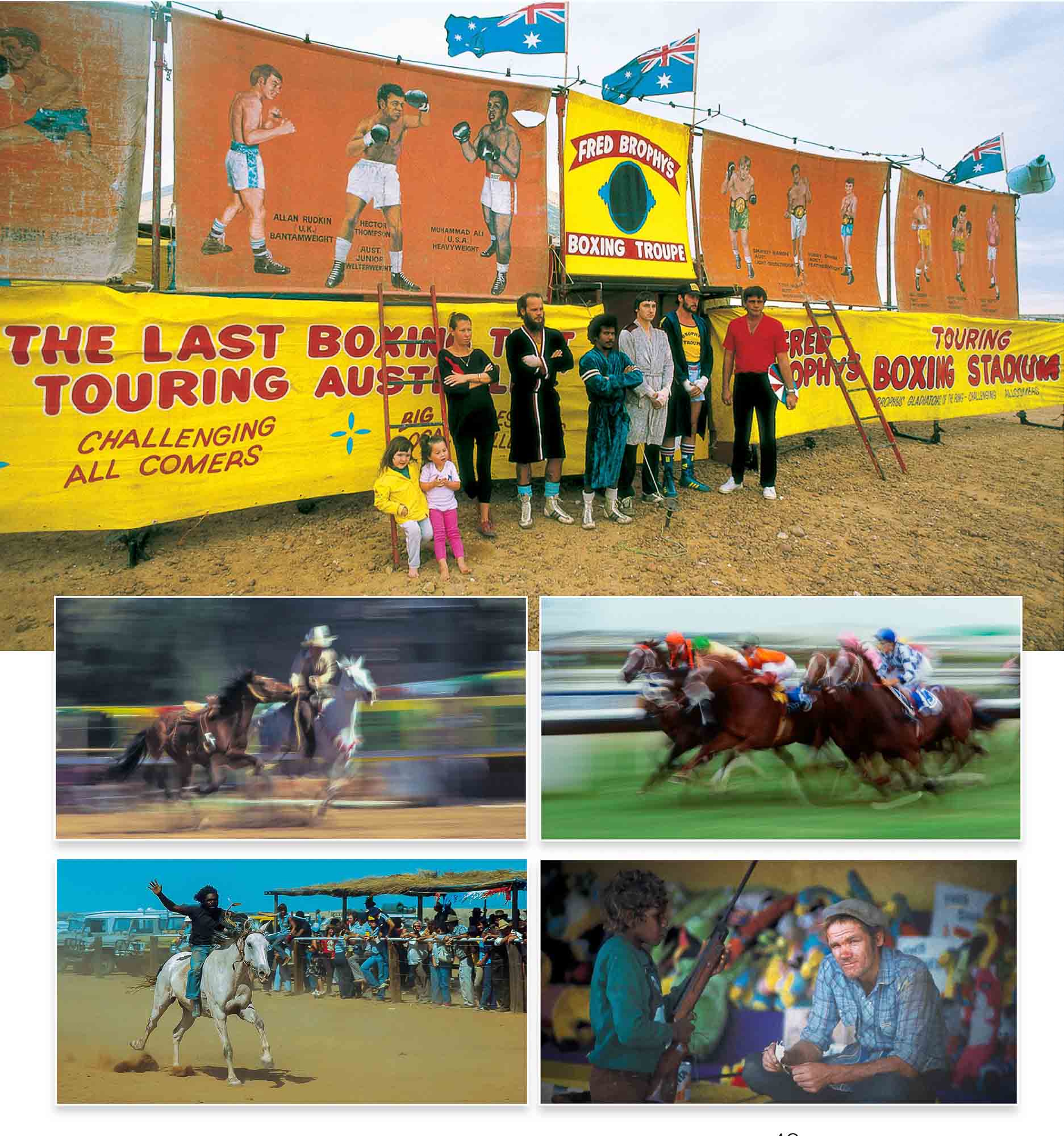
Making connections: rodeos, gymkhanas & country races
If you are drawn to connect with authentic Aussie characters, Australia’s outback and country rodeos, gymkhanas, and race meetings provide marvellous opportunities. When I want to make images with a real Aussie twist, these are the places I visit, and the more isolated, the better. The image inset at lower left was made in 1984 at the Flying Doctor Fundraising Gymkhana at William Creek, South Australia. Kego, the young Indigenous rider, behaved like a winner although he lost the race. Note that no-one in the crowd is even watching him come past the post. He found that his horse refused to take a turn!
Even apart from the main event, opportunities abound to photograph quintessentially Australian characters. For example, Fred Brophy’s Boxing Troupe has established itself outside the Birdsville Pub at the Birdsville Races for decades. The annual races are one of Australia’s most famous outback attractions and the boxers are usually colourful characters.

Rural & outback events
I certainly have mixed emotions when it comes to rodeos, camp drafting and racing events. Nonetheless, if you are on a photographic storytelling mission, these events are integral to the culture of the Australian outback. If you have travelled from the United States, you would also be familiar with these activities. In remote areas, this may be the only time these hard-working bush people play hard instead, letting their hair down and catching up with friends who may live hundreds of kilometres away. I have met some wonderful people and created some very memorable images at these outback events. I suggest you scan the internet well ahead to try to time your passing through with attending one of these occasions.

Managing the mob
Indigenous stockman bring in a wild mob of cattle on Mallapunyah Springs Station, Barkly Tableland, 1984. Mallapunyah was settled by George and Elizabeth Darcy in the mid-1920s. I had heard of this famous family while wandering the outback and simply knocked on the front door and asked permission to photograph a muster for a book on the Australian outback. Over a very strong, red-hot mug of black tea, the grandfather penned a mud map to where a major wild cattle muster was taking place.
Arriving, I was greeted with a few grunted warnings not to stand downwind or be visible when the cattle were mustered in. Due to the dangerous wild cattle, I hid behind a bush and used a 600 mm lens to create this image. The impression of the Indigenous stockmen working those cattle will remain with me forever. This is a very dangerous activity. In 2017, Jimmy Darcy was trampled to death when his horse fell during a stampede in the Kimberley. If you see cattle being mustered roadside during your travels, remain respectful and stay well back. The cattle may look gentle and under control; however, their temperament can change rapidly.

Adding keywords
While this roughly assembled theme of outback character portraits seems to follow a “hat” theme, this is entirely a result of the editing process. As you collect and catalogue your work, you may choose to add certain keywords like “hat” or “hair” (coming on a later page) or “wool” or “sheep” (on the following page). The key wording process achieved in post-production not only helps the creation of themes for possible later posts, blogs, or even books, but also helps focus attention on the many aspects that will confront you while wandering the streets and country byways in search of images.
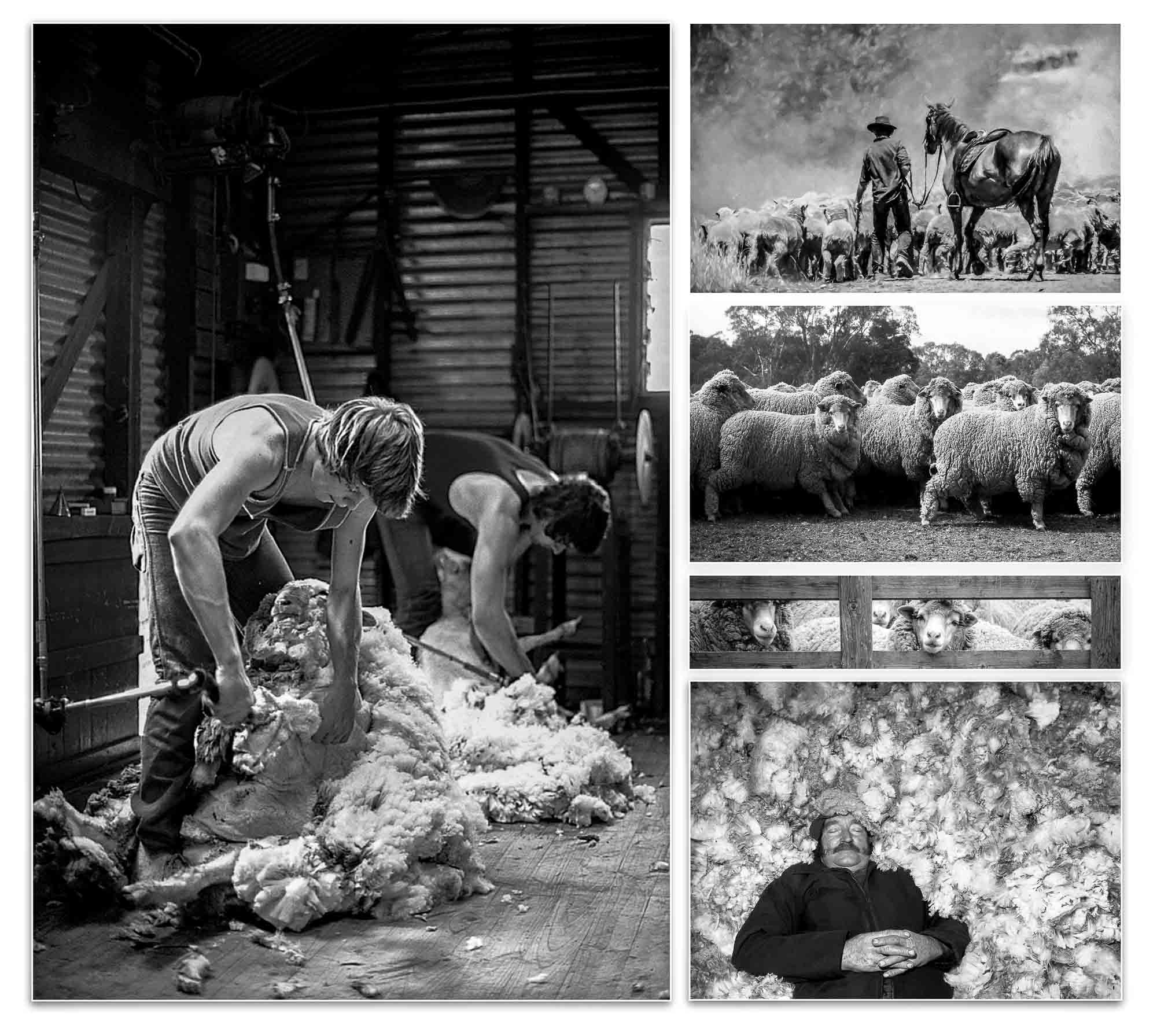
Photo storytelling
Creating a storyline in your mind’s eye is a skill set you hone over time. These images, which collectively paint a picture of the process from mustering, yard working, shearing, and relaxing (the sleeping “gun shearer” ) are of higher value as a complete photographic story.

Top 10 Photo Tips
- If you are working on a project, go without your cameras and talk to people about what you would like to do. This strategy works well in small communities: a cattle camp, a homestead, an Indigenous community. To make excellent pictures of people, you need to connect, maybe not with the individual but certainly with their culture and traditions.
- Be very selective. Look for interesting faces and people who look as if they belong to the place you are in. Unguarded, unposed expressions usually work best, although people aware can also be fun.
- Trust your instincts. If something looks and feels good, shoot it and think later. Spontaneity is crucial! I have a memory full of missed prize-winners!
- I don’t usually ask permission when I’m in a very public place. I try to blend in by being casual and not dressing like a professional photographer. In those instances, I certainly don’t carry three cameras!
- Don’t move on from a shoot until you have tried every possible angle. If you began taking shots of people unaware, talk to your subject to make them aware of the camera and keep shooting.
- If you make a shot and your subject gets hostile, turn your camera away and keep shooting something else. This can quickly defuse the situation.
- Watch the body language of your subject. It is far more important than the surroundings.
- If someone looks daggers at you even before you take a picture, put your camera aside and introduce yourself and your mission. Alternatively, walk away. It is legal to photograph people for non-commercial purposes in Australia in public spaces, but courtesy is the key. Read up on your rights at Arts Law: a must-read.
- If you are on foot and feel your subject may be resistant, try shooting without breaking stride or apply zone focusing techniques. Photographing from a car can produce great results. After all, the car can be a mobile hide.
- Keep your cameras and kit simple, for example, an SLR with a zoom lens but without a motor drive. Even better is a simple rangefinder camera.