
Australian Natural History:
Kangaroos & Wallabies
Text and Photography & text Steve Parish – Profiles Karin Cox
Even while I was working with macropod experts in the Queensland National Parks and Wildlife Service, kangaroos and wallabies didn’t capture my imagination the way they do today. Of course, I had photographed the big red roos sprinting across Queensland’s western plains. Sure, agile, red-necked and whiptail wallabies had been recorded when the chance arose, but it was more opportunistic than deliberate. Although I had plenty of colleagues who were researching kangaroos and wallabies, my own connection was yet to occur. It was not until 1983, during a year-long trip around Australia, that I began to realise these animals were more than just hopping mammals that carried their babies in pouches.


In the autumn of 1983, I arrived in the Gammon Ranges (above), just north of the Flinders Ranges in South Australia. I was collecting images for a book, Australia’s Wilderness Experience, to be written by Allan Fox, a renowned environmentalist and educator. Ironically, my first “wilderness experience” was to photograph feral goats. While waiting for goats to descend to drink at the waterholes in the late afternoon, I filled my time watching the behaviour of wallaroos, which were abundant in that area. After hour upon hour of watching these mammals, I began to see that they were quite fascinating. I noticed how the young males and females reacted to the adult males, and how acutely aware they were of everything that was happening around them. Their agility when negotiating steep, seemingly impassable cliff faces was incredible. Boy, these animals are at one with their habitat, I thought to myself.
The word “kangaroo” derives from the Guugu Yimithirr word gangurru, referring to grey kangaroos. The name was first recorded as “kanguru” on 12 July 1770 in an entry in the diary of Sir Joseph Banks; this occurred at the site of modern Cooktown, on the banks of the Endeavour River, where HMS Endeavour under the command of Lieutenant James Cook was beached for almost seven weeks to repair damage sustained on the Great Barrier Reef. Cook first referred to kangaroos in his diary entry of 4 August. Guugu Yimithirr is the language of the people of the area.

A fascination begins – Previously, on assignment for a book about Australia’s Great Dividing Range, I had photographed expert rock-climbers at Mount Arapiles in Victoria, but the wallaroos would put these guys to shame! While gazing through my lens into the dark, liquid eyes of a “teenage” doe (opposite), my macropod fascination began. It would later continue to build, with increasing passion, as I set out to record as many examples of macropod behaviour as possible in my lifetime. My fascination now extends to all fifty living Australian species (six species have become extinct since European settlement) and numerous behavioural aspects.

Above: Many macropods are easily identified when their heads are seen in profile, so I create profile portraits of all new species I encounter. This montage represents half of all the macropods found in Australia today.
Experience has taught me that it is helpful to have a basic understanding of the taxonomic classification of a group of animals before I set out to photograph them. Since my early experiences with fish and marine invertebrates, I can far better appreciate observations in the wild knowing a little about how the different genera evolved and where they “fit” within an order. Over the past two decades, numerous television programs, books and articles have featured the astonishing mammals in the Macropodoidea superfamily, so it stands to reason that few creatures symbolise Australia as successfully. Three families within the superfamily are often referred to as macropods, although the correct term is “macropodoids”. They include the potoroids (potoroos and bettongs); the sole living member of the Hypsiprymnodontidae family (the unique musky rat-kangaroo) and the larger “true macropods” in the Macropodidae family (pademelons, tree-kangaroos, kangaroos, the quokka, wallabies, and rock-wallabies). Compared to other mammals, macropods’ bounding gait, pouch young, boxing stance and tough disposition make them highly original, and, for me, simply enthralling.
Twelve Favourite Macropods

Musky Rat-kangaroo
The Musky Rat-kangaroo is an oddity, the lone surviving member of its family. It is also the only rainforest marsupial known to hoard seeds and fruits by burying them beneath leaf litter; consequently, it is an important ecological disperser of rainforest plants and one of the few marsupials that might provide compelling clues to the origin of extant marsupials.
Dwelling on the forest floor in moist tropical rainforests in north-eastern Queensland, from Mt Lee to Mt Amos, near Cooktown, this creature is among the few wholly rainforest-dwelling marsupials in the world and prefers habitat of less than 1200 m altitude.
Dietary components vary throughout the year, depending on availability, but it is mostly a fructivore that prefers rainforest fruit, supplemented by invertebrates and above-ground fruiting bodies of fungi. This species is not designed for excavating underground fruiting fungi like the potoroids, but will sniff and forage in the leaf litter opportunistically for food.

Northern Bettong
Also known as the Tropical Bettong, a common name which is reflected in its species epithet, the Northern Bettong is endemic to Queensland’s tropical north. Smaller and more dainty than its southern kin, it is a dedicated truffle eater that seeks out ectomycorrhizal fungi by smell and digs it up using its sturdy forepaws.
Isolated populations occupy parcels of eucalypt woodland growing on granitic soils and dominated by Lemon-scented Gum, Poplar Gum, bloodwoods, grass-trees, tea-tree and Red Stringbark. All are at 400–1200 m altitude and on Mt Windsor and Mt Carbine tablelands of north Queensland, or on the Lamb Range and at Mount Zero.
Northern Bettongs use their forepaws to excavate and devour truffles, leaving the outer husk and eating the spores inside. More than half of their diet is made up of this delicacy, but they also consume invertebrates and stems and tuberous material from grasses such as Cockatoo Grass, as well as lilies and orchids.

Lumholtz’s Tree-kangaroo
Known to Indigenous peoples of the region as the Boongarry, Mabi or Mapee, this inhabitant of dense rainforest between the Mt Carbine Tablelands and Cardwell Range, appears to prefer rainforest that grows on basaltic soil and may once also have inhabited coastal rainforests at lower elevations. Available patches of habitat have shrunk considerably as the continent dried out since the Pleistocene and as the result the species lacks genetic diversity.
Like Bennett’s Tree-kangaroo, they are nocturnal and solitary, aggressively defending a home range of 0.7–2.0 ha for female and 1.9–2.1 ha for males. Lumholtz’s Tree-kangaroos are very dedicated to their territory and may be reluctant to abandon it even if it sustains damage or is partially cleared.
As many as 37 species of vines, trees and fruits are consumed, including the Black Bean and Pepperberry Trees and some that are poisonous to other mammals, such as the Shining Stinging Tree, Wild Tobacco and Lantana.

Rufus Hare-wallaby
Another small mammal to have declined since the 1800s, the Rufous Hare-wallaby once occupied the greater part of Western Australia, the Northern Territory and South Australia’s arid and semiarid lands. Historical reports even note its abundance and it was a common food source for Indigenous people and is recorded in Dreaming mythology of the desert Aborigines, who reportedly hunted it by following it to its hide, stomping on the burrow entrance then digging the animal out.
Recorded from the Gibson, Great Sandy and Tanami Deserts, this species has vanished from its former haunts and is confined to Bernier and Dorre Islands off Western Australia, and a captive-bred population on Trimouille Island. Relocation to former parts of its range in the Tanami Desert failed, probably due to the feral cat. Spinifex hummock grassland, sandy dunes and the fringes of salt lakes were its preferred environments on the mainland, usually close to old drainage lines containing sparse paperbark shrub and termite mounds.
Grasses, forbs and the tips of Spinifex make up most of its diet, but it will also eat insects and seeds in drought, benefiting from the higher water content. It is also known to feed on succulents that grow on salt flats or burnt areas.

Spectacled Hare-wallaby
This mid-size hare-wallaby is one of the most strikingly patterned of its genus, with rufous rings around the eyes making it easily distinguishable from other small wallabies.
It is known to patchily inhabit tropcial grasslands, open woodlands, forests, tussock-grass shrublands and even hummock grasslands and survives in small populations in the wattle shrubland of the Tanami Desert and in the Pilbara region of Western Australia and Barrow Island, as well as on Cape York, Queensland. Once considered by Kimberley Aborigines to be rather common, it is now only very sporadically sighted there. It reaches its highest density on Barrow Island, off the Western Australian coast, where the feral cats are absent.
Most of its diet appears to be grass and forbs, particularly legumes, but it is also known to eat shrubs and the tips of Spinifex leaves.
Predation by the Feral Cat has been linked to a decline in populations and a contraction in range. Land use and pastoral practices, competition with grazing stock, and altered fire regimes may also have led to its contraction in range.

Antilopine Wallaroo
Monsoon woodlands and thick eucalypt woodlands close to dense, grassy wooded areas in the tropics are the prime haunt of the Antilopine Wallaroo, one of Australia’s most little-studied macropods.Gould referred to it as the Red Wallaroo and illustrated it under the scientific name Osphranter antilopinus, noting its large size. It is among the most sociable of the wallaroos, forming small mobs that operate under a hierarchy.
Like typical wallaroos, this species is occasionally found in hilly terrain but is more common in flat, wooded areas. Its range on Cape York and in the top end of the Northern Territory and the Western Australian Kimberley overlaps that of the Common and Black Wallaroo, as well as the Eastern Grey and Red Kangaroo.
Grasses and forbs make up most of the Antilopine Wallaroo’s diet. In the late afternoon they move to feeding grounds and continue to graze into the night, returning to cover at dawn.


Eastern Grey Kangaroo
Eastern Grey Kangaroos date back at least 4 million years in the fossil record, evidence they existed for relatively long time before Red Kangaroos or the short-faced mega kangaroos. A remarkably successful species, Eastern Greys are the kangaroos most visitors to Australia will interact with in fauna parks, national parks and campsites and were made famous by the 1960s television program Skippy the Bush Kangaroo, which starred a female Eastern Grey.
They dwell in patches of habitat that receive 200–1900 mm of rainfall annually, but their preference is generally for dry eucalypt forest, heathlands, shrubland, woodlands and mallee shrub that receives about 600 mm a year. Less arid-adapted than the Western Grey or Red Kangaroo, the increasing availability of free water thanks to agricultural pursuits has increased their range west of the Great Dividing Range and they now extend inland to the Dingo fence that borders South Australia and from Cape York, Queensland, to New South Wales, Victoria and Tasmania.
As much as 99% of the diet is made up of grass, supplemented by soft herbs, ferns, bark and the seedlings of some trees and shrubs, as well as some agricultural crops. Molar progression enables them to continue to graze on what is an abrasive diet and a sacculated stomach facilitates fermentation of cellulose. Eastern Grey Kangaroos feed just before sunset, foraging through the night and seeking cover shortly before dawn. They are known to graze on golf courses, in pine plantations, or anywhere that provides acceptable cover close to grassy foraging grounds.


Red Kangaroo
An iconic Australian mammal that represents the nation at a Federal level on our Coat of Arms and is also the mascot for Qantas, Australia’s national airline, the Red Kangaroo is unmistakably distinct from the smaller kangaroos and wallabies. This supremely arid-adapted marsupial dwells in every Australian State with the exception of Tasmania, and inhabits even the inhospitable Red Centre. Gould called it “not only … the most beautiful member of the family to which it belongs, but … the finest of the indigenous Mammals of Australia yet discovered; its large size, great elegance of form, and rich and conspicuous colouring all tending to warrant such an opinion.”
Red Kangaroos are the world’s largest marsupials, standing more than 1.4 m tall, and are among the most sexually dimorphic of macropods. Males are much larger than females, exhibiting the typical rusty red coat brought to mind by their common name.
A mammal of the open plains, grasslands and flood plains, the Red Kangaroo reaches its highest population densities in Queensland and central New South Wales in regions that are also prime sheep grazing habitat. They are also sometimes seen in areas of higher rainfall, including woodlands and irrigated pastoral lands.
Grass and herbs, especially short new shooting grass such as Five Minute Grass, comprise the bulk of its diet in summer. When the season is less favorable it also consumes forbs and shrubs and will travel as far as 50 km to take advantage of fresh green pick following infrequent rain. Young males, which are generally more transient than females, may even cover a distance of several hundred kilometres over three or more months.

Western Brush Wallaby
Endemic to the south-west corner of Australia, the Western Brush-wallaby is sometimes also known as the Black-gloved wallaby, a references its black fore- and hindpaws. Among the largest of Australia’s wallabies, it is an inhabitant of open forest, woodlands and floodplains and is primarily a grazer.
It is distributed from Cape Arid to just north of Kalbarri National Park in South-West Western Australia and prefers open forests and woodland with an understorey of low grasses or scrubby thickets. It also frequents heathland, but avoids tall or wet sclerophyll forest where the undergrowth becomes too dense.
A grazer, presumably grass makes up most of its diet, although few studies have focussed exclusively on the Western Brush-wallaby. One study that did found that they consume as many as 29 plant species, among them the Hottentot Fig, Couch Grass and Christmas Tree. Indications are that it does not need free water.

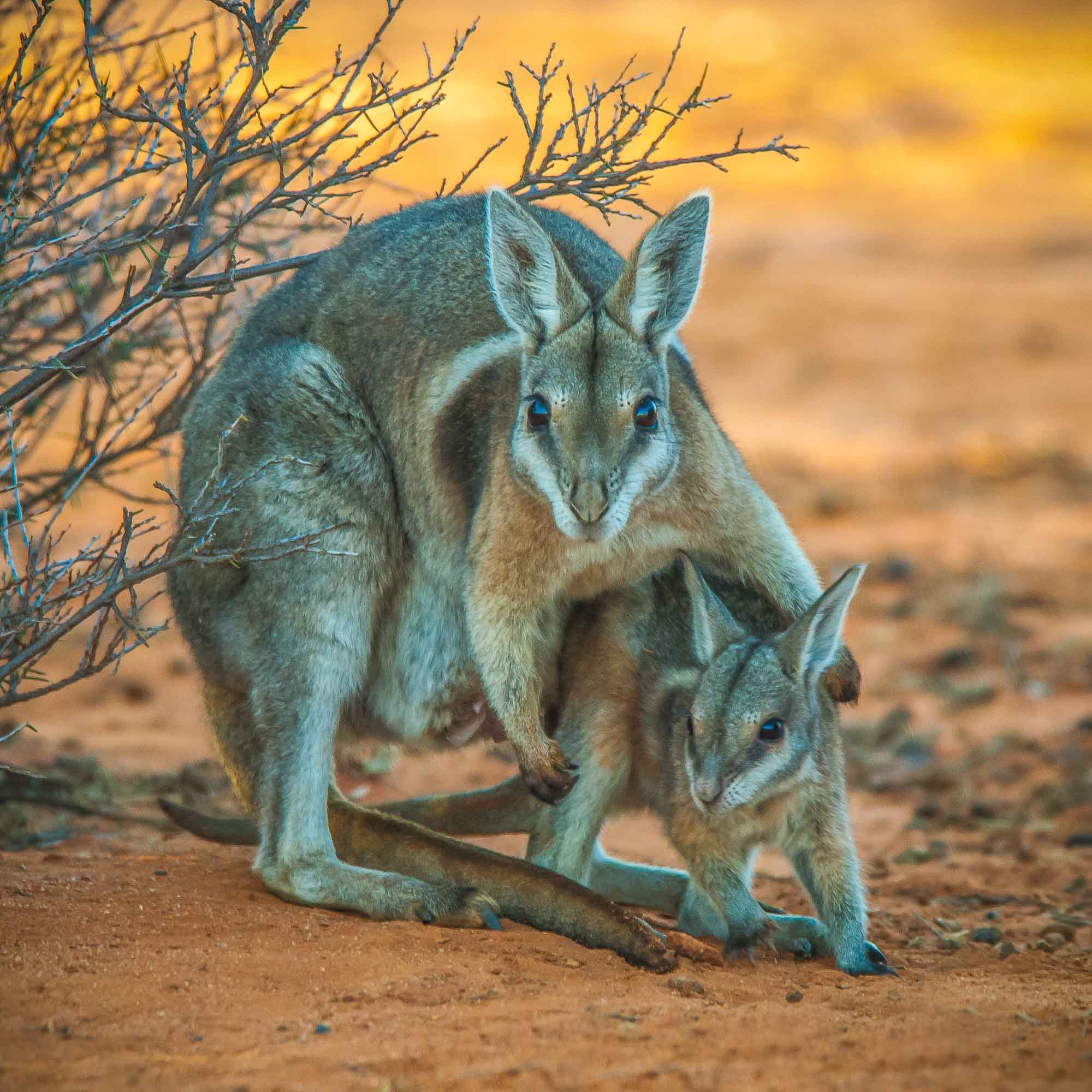
Bridled Nailtail Wallaby
The Bridled Nailtail Wallaby is a mammal of the continent’s eastern inland, but has fared badly since European colonisation. Once known colloquially as “Flash Jack” thanks to its speed and beautiful colouration, this wallaby was distributed inland from Queensland to Victoria. Gerard Krefft once wrote that it was “the most common of the smaller species of the kangaroo tribe”, but despite that it was thought be extinct by the 1930s. In 1973 it was rediscovered by a fencing contractor, one Mr Challacombe, who had been hired to enclose an area of scrub near the town of Dingo. Fortuitously, Mr Challacombe carried with him a copy of Woman’s Day magazine, which contained an article on extinct animals. He noticed that an illustration of the Bridled Nailtail Wallaby, drawn in the 1840s, closely resembled the animal he had seen on the property and hence the continued existence of this marsupial was discovered.
The Bridled Nailtail Wallaby is a semiarid-adapted wallaby that dwells in open gum tree forest, brigalow scrub and acacia woodland on the dry slopes and plains west of the Great Dividing Range. It is a fringe dweller, preferring an edge habitat where denser vegetation meets suitable grazing plains, shrubland or grassy woodland. Now surviving in a natural wild population only in a restricted, 11,400-ha parcel of land known as Taunton Scientific Reserve near Dingo in Queensland, captive-bred individuals have been introduced to the Australian Wildlife Conservancy’s Scotia Sanctuary in New South Wales and a translocated population exists in Idalia National Park, central Queensland. In the mid-1800s it was distributed from Charters Towers in Queensland to the banks of the Murray River in Victoria.
More prone to browsing than most macropods, the Bridled Nailtail feeds on succulents, forbs, soft-leaved grasses, and leaves from the Emu Bush during drought or seasonally arid periods. When feeding, it remains close to cover, usually moving fewer than 200 m from grassy or shrubby cover.
Hunting for the fur industry in the mid nineteenth-century exacerbated its decline, as did competition with livestock, and drought in the 1990s. The Wedge-tailed Eagle, Dingo and Feral Cat are assiduous predators of juvenile Bridled Nailtail Wallabies.

Yellow-footed Rock-wallaby
Arguably Australia’s most attractive rock-wallaby species, and the largest species in the Petrogale genus, the distinctive Yellow-footed Rock-wallaby is easily distinguished from its relatives by its flamboyant markings and long, rufous to black-ringed tail. As a result of its beauty in the late 1800s it was ruthlessly exploited for its fur, which led to declines in some areas of its range, especially in South Australia.
This species’ coat is fawn-grey above but several other colours lend it a lovely contrast. The limbs and tails are a rich orange-yellow, the belly is white, the ears are long, pointed and orange, and the face has a distinct white stripe on the cheek below brown fur on the muzzle. An off-white side stripe and brown and white hip-stripe add to its appeal. Also distinct is a brown mid-dorsal stripe from the crown to the centre of the back. The limbs and feet are a bright orange–yellow and the tail is rufous-brown with darker “rings” and either a brown or white tip.
The Yellow-footed Rock-wallaby exists only in a very small, captive-bred population in Queensland, near the town of Blackall, in an even smaller population in north-western New South Wales, and in three populations in South Australia. All are patchily distributed in rocky terrain surrounded by a mosaic of semi-arid vegetation and woodland close to water.
Grass, forbs and sometimes the foliage from trees and low-growing shrubs comprise its diet.

Quokka
Monotypical and confined to the south-west of Western Australia and Rottnest Island, where it reaches its highest densities, the stout, chubby-cheeked Quokka deserves its reputation as one of Australia’s “cutest” macropods.
Populations dwell in the Jarrah, Karri and Marri forests of the south-west and are patchily distributed in Stirling Ranges National Park. A mosaic of habitats are preferred by this species and it may be that changed fire regimes, which did not support a patchwork of different vegetation in various stages of regrowth, have contributed to contracting its mainland range. Habitat consists of Paperbark and Wattle thickets, Tea-tree swamp that fringes waterways, as well as sedgeland of Gahnia species and tall dry eucalypt forest. It once ranged east as far as Fitzgerald River National Park and was abundant around Albany, even being considered an agricultural pest, although is now Vulnerable and reaches its highest density on Rottnest Island.
Gregarious and mostly nocturnal (although they are much more diurnal on Rottnest Island and may be seen about by day), Quokkas from small groups that exist under a hierarchy governed by the oldest males. Nest sharing and mutual grooming are common Males cluck softly when courting females in oestrus.
The Quokka’s diet is more specialised than that of most macropodoids. It is primarily a browser, gaining sustenance from grass, leaves, sedges and succulent plants.
Macropod gallery – click and scroll