
The Art of Birds
‘We can choose to follow the paths of others.
Or we can inspire our own
creative life purpose and truly
feel the wind beneath our wings.’
Steve Parish
As of 2014 Australia and its offshore islands and territories have 898 recorded bird species. Of the recorded birds, 165 are considered vagrant or accidental visitors, of the remainder over 45% are classified as Australian endemics: found nowhere else on earth. That’s a lot of birds!
We live in a blessed country when it comes to birds. Many thousands of Australians capitalise on these blessings, especially those Australians with verandahs and bush gardens who are able to enjoy their bird fauna on a daily basis. What has provided such a unique assemblage is the unique nature of Australia’s eucalypt and paperbark forests which has shaped bird evolution. Gum blossoms, for example, produced a resource for significant numbers of nectar-feeding honeyeaters.
As Tim Low, in his classic book ‘Where Song Began: Australia’s Birds and How They Changed The World’, points out, the presence of much nectar as a jealously guarded resource may be why so many Australian birds are raucously noisy – species such noisy miners, rainbow lorikeets and various wattlebirds to name a few. And, what would life be like without the raucous kookaburra announcing its presence mornings and afternoons!
Above: ‘Your Way, My Way’ – The New Holland honeyeater is a common honeyeater species found throughout southern Australia. It is fun to watch their antics.

The Finest Songster
‘Sound is spirit-food
for artists who strive to two-dimensionally
encapsulate a multidimensional world,’
Steve Parish
Lyrebirds are most notable for their superb ability to mimic natural and even artificial sounds from their environment; they are also the world’s largest songster. Another feature is the striking beauty of the male bird’s huge tail when it is fanned out in courtship display. This is the superb lyrebird, one of two species. Superb lyrebird – captured while calling – are referred to as weringerong, woorail, and bulln-bulln in Aboriginal languages throughout their range.

The Golden Hour
One of my favourite birds, the golden bosun bird, seen here is aerial courtship, is endemic to Chrismas Island; an island in the Indian Ocean which is an external territory of Ausralia.

Silent In The Night
Barn owls specialise in hunting animals on the ground and nearly all of their food consists of small mammals which they locate by sound, their hearing being very acute. When in flight they are completely silent. They mate for life unless one of the pair gets killed.

Carnaby’s Black Cockatoos
Carnaby’s black cockatoos nests in Eucalyptus hollows situated high in trees. With much of its habitat lost to land clearing and development and threatened by further habitat destruction, Carnaby’s black cockatoo is listed as an endangered species by the Federal and Western Australian governments. It is also classified as endangered by the International Union for Conservation of Nature (IUCN). This family group from its northernmost distribution at Kalbarri National Park is a rare sighting, certainly rare in terms of being able to approach the birds as a group.

Private Investigations
Most Australian east coast backyards are investigated at one time or another by the delightful rainbow lorikeet? After one flowering season and a natural morning awakening by these noisy birds, I was inspired to write this verse.
With nervous flits and flutters
these brightly coloured birds
fold back
their flying feathers
while dashing down the rainbow,
on what must surely be
a never-ending journey
to try
to catch the sun.

Major Mitchell Cockatoo
Major Mitchell’s cockatoo, also known as pink cockatoo, is a dramatic medium-sized cockatoo restricted to arid and semi-arid inland areas of Australia. A flock of pink cockatoos in flight during the golden hours of morning or afternoon is a sight to behold.

Unheard Whispers
A barking owl setting out to hunt in the late afternoon light.

Royal Excitement
During the breeding season male royal spoonbill’s raise raise extended head feathers as a sign to a female that they are excited and ready for action.
The Pelican – Australia’s Favourite Bird
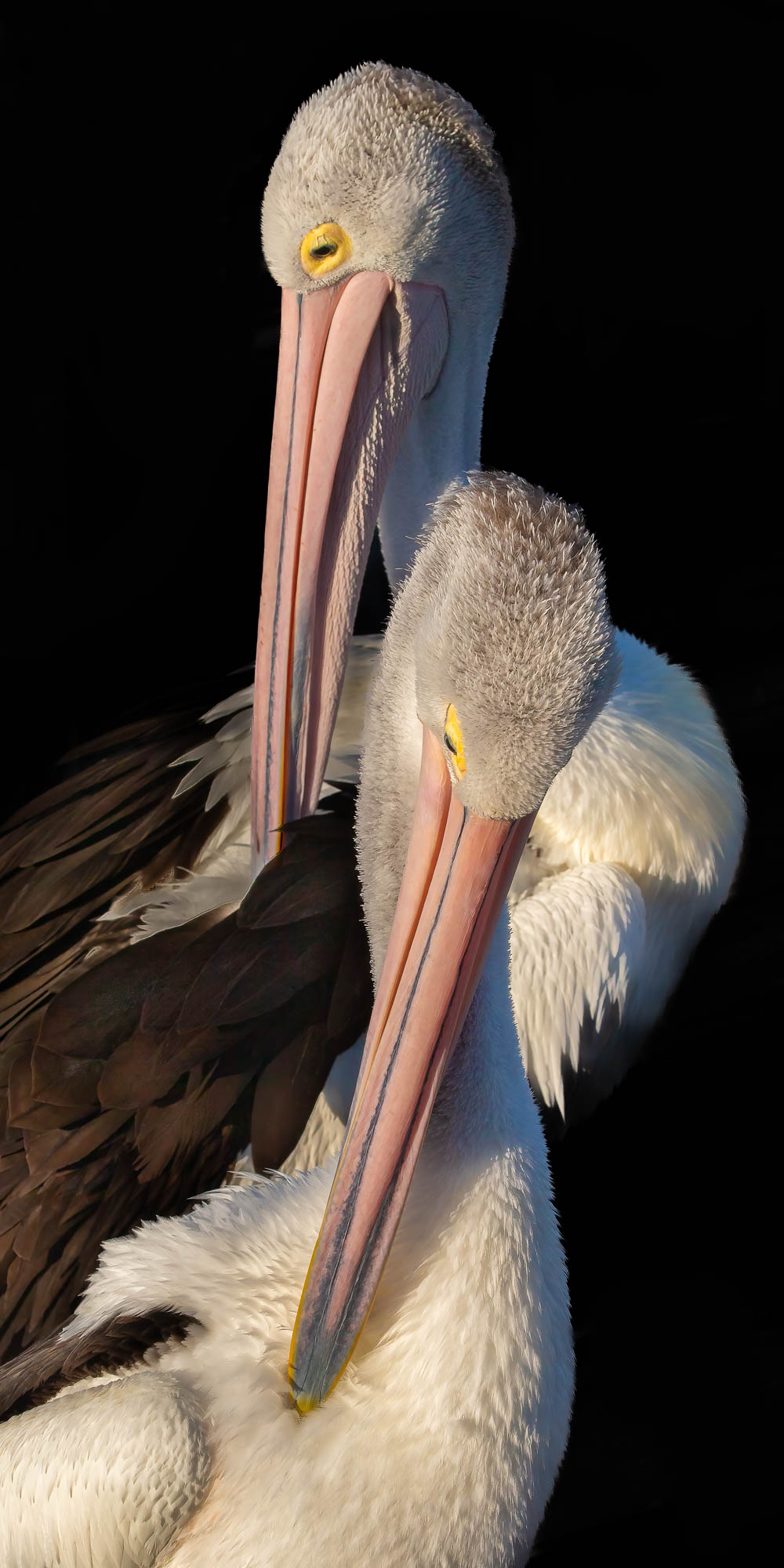
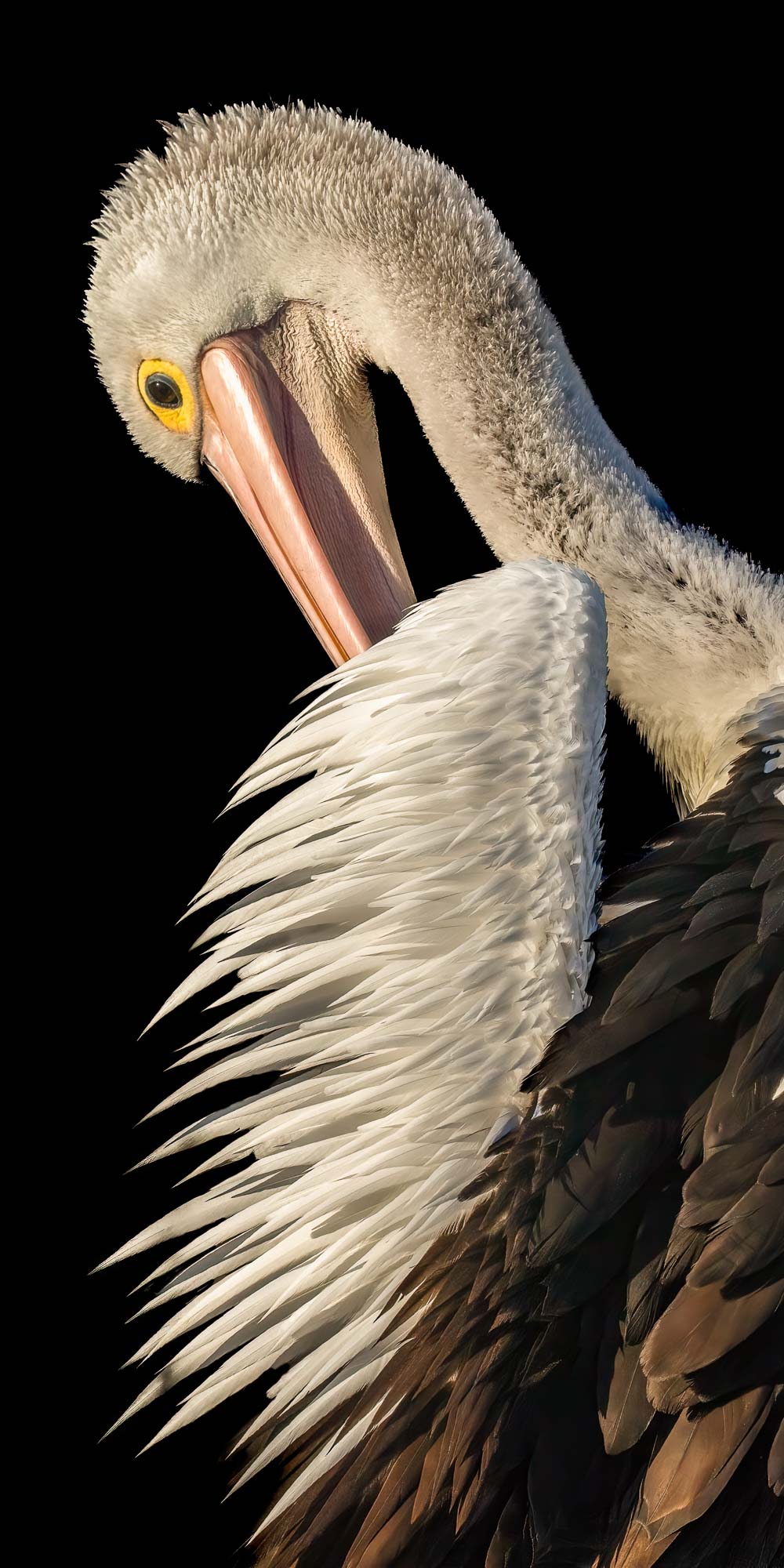
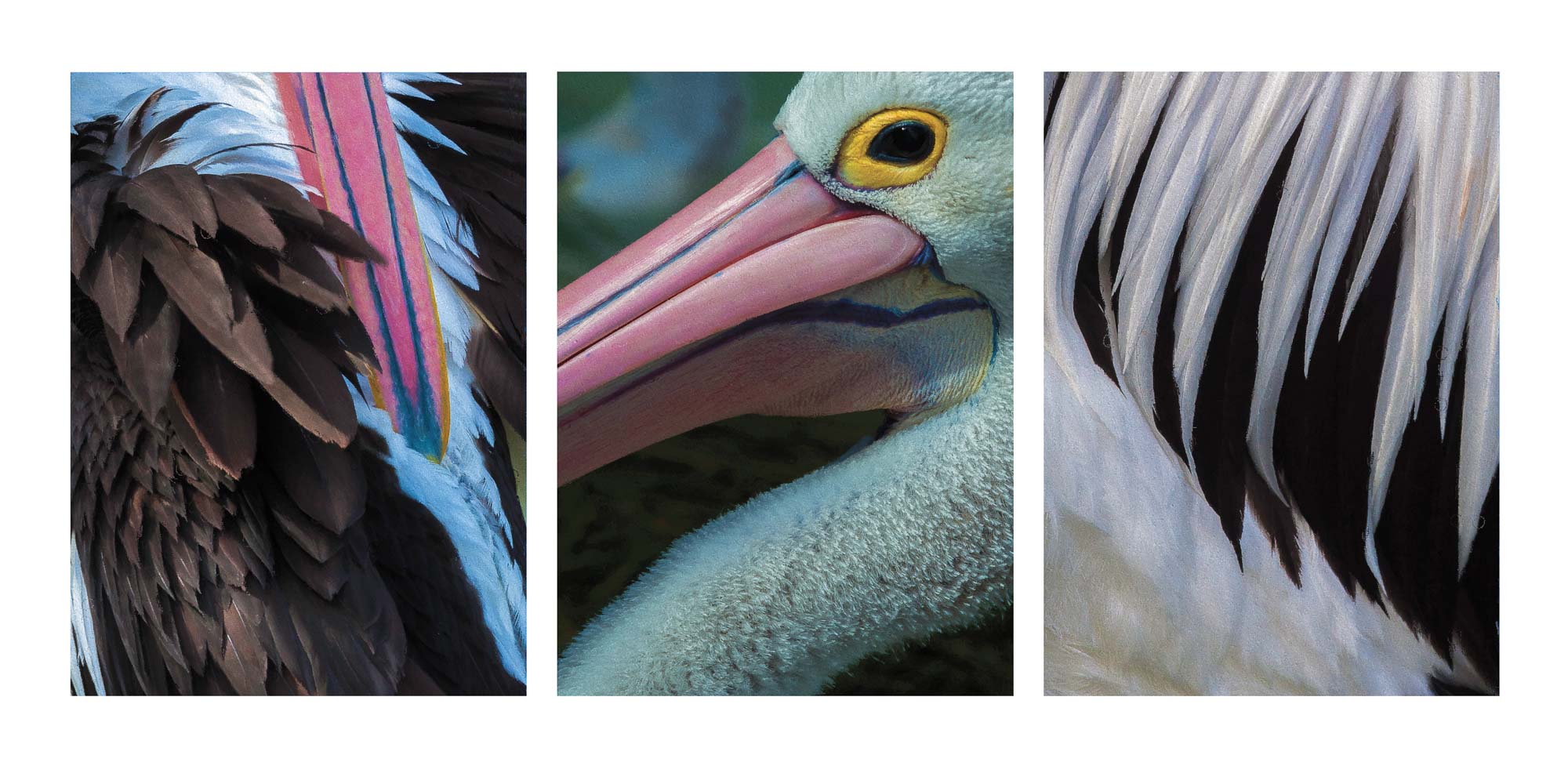
The beloved Australian pelican is Australia’s most famous bird. These enigmatic birds occur across large expanses of mainland Australia and Tasmania. The habitats that support them include lakes, reservoirs, billabongs and rivers, estuaries, swamps, temporarily flooded areas in arid zones, drainage channels in farmland, salt evaporation ponds, and the coastal region’s lagoons. They may form enormous colonies when breeding, usually in isolated arid environments like Lake Eyre or Queensland’s Channel Country. The Australian pelican is a much-loved bird. I often sit for hours with these birds, watching their artful contortions as they stretch and preen. This triptych comes as a single image.

Stary, Stary Night
Some years ago I was working with a group of children who were fearful of the Australian bush at night. As we then explored the sounds of the dark, I could see their fears ebb away as they delighted to the sounds I played as an old male koala’s erupted in its territorial grunts, as some bickering possums fought, as a pond filled with frogs erupted with mating calls. They especially loved and the whooping and hooting of owls.

Freedom
Wedge-tailed eagles are an emblem of the Northern Territory. These birds are the largest and most certainly the most renown Australian bird of prey.


Graceful Stance – Artful Posture
Above left: The shape and form of the herons and egrets I find alluring as photographic subjects.
Above right: Framed by Barringtonia freshwater mangroves a glossy ibis takes an artful pose while preening.


A Ring of Ripples – The Golden Hour II
Above left: It is pure joy when a number of aesthetic elements come together creating a unique artful story. Of course, birds have most certainly got a mind of their own, and absolutely anything can happen, and it does. Nonetheless, bird photography, as a past-time is, without a doubt, the most challenging and spiritually satisfying in the world of nature photography. Here the colours reflected in the water and on the bird’s feathers were most pleasing in and of themselves, however when the bird gracefully dipped its toes ever so briefly creating a ring of ripple, well that’s another thing. While birds in flight can be the ultimate challenge, I adore following a bird going about its private business watching and waiting for that unique little ‘twist of lemon’. In this case, the ‘toe-dipping’ created the magic….ah, what joy! I have been known to shout out load a ‘yes’, although I do keep the sound entirely in my head, who knows my Ibis may perform something as equally magical if I am prepared to lie silently in wait.
Above right: Black-necked stork bathed in golden light on the vast floodplains Kakadu National Park, Northern Territory


Tucked Away – The Watcher – Blue-winged Kookaburra
Left: At the end of each day, Australian pelicans have this delightful behaviour of wrapping the big-bills and as much of their heads as possible among the folds of their contrasting black and white feathers. It is this graphic alignment that inspired this image.
Centre: Tawny frogmouth, common yet uncommonly encountered due to its ability to camouflage so well with tree branches and foliage.
Right: The blue-winged kookaburra is slightly smaller than its renown relative, the laughing kookaburra. This species occupies the same territory throughout the year. It is monogamous, retaining the same partner for life. A breeding pair can be accompanied by up to five fully grown non-breeding offspring from previous years. In this work, I have focussed on the drama of its striking blue-wing.