
Creative Life:
Seizing Pivotal Life Moments
People with creative life goals succeed
because they know where they are going.
– Steve Parish
At 79, I can look back on a life shaped by pivotal, life-changing moments. The first — and perhaps the most significant — occurred when I was sixteen.
While spearfishing at Moana Beach, just south of Adelaide, I encountered a great white shark. It took my catch and left me with a surge of curiosity rather than fear. What was that enormous, mean-looking shark? With no fish books to consult, I took my questions to the South Australian Museum. Based on my description, the shark was quickly identified as a great white, and — noticing my enthusiasm — a generous biologist invited me to join a newly planned fish-collecting expedition along the north coast of Kangaroo Island.
On board was Igor Oak, an underwater photography pioneer. Through sheer good fortune, and his willingness to share, he handed me his camera underwater and gestured for me to make a picture. From that moment, I gave up spearing fish and began photographing them. I didn’t realise it then, but my life’s journey had quietly begun.
There have been many such pivotal moments since. They come to all of us, especially once we recognise the activities that bring us joy. At first, dreams and aspirations may seem uncertain or impractical — but they can still serve as beginnings. It took me twenty years from discovering my passion to recognising it as a viable, independent way to earn a living.
Throughout my life, I’ve learned the value of regularly reviewing progress, staying open to opportunity, and being willing to explore paths that may initially seem unlikely.

One experience stands out.
In 1975, at twenty-nine, I was preparing for a dive at Julian Rocks near Byron Bay with a friend. Unsure of my direction at the time, I mentioned this uncertainty after the dive. My friend suggested I might find work as a photographer with the Queensland National Parks & Wildlife Service, which was developing an in-house education unit. He offered to make enquiries.
The following week, he told me the Service had just begun building a new statewide education department — and they were hiring photographers. That single opportunity opened many doors. It allowed me to combine photography with marine science and to help interpret nature for the broader community. Eventually, I found myself in a tropical forest photographing the Service’s new logo — the Herbert River Ringtail Possum. Ten years later, I launched my publishing brand.
Looking back, I see how often confidence grows not from certainty, but from curiosity, openness, and the courage to follow what feels meaningful.
Do you recognise the pivotal, life-changing moments in your own life?
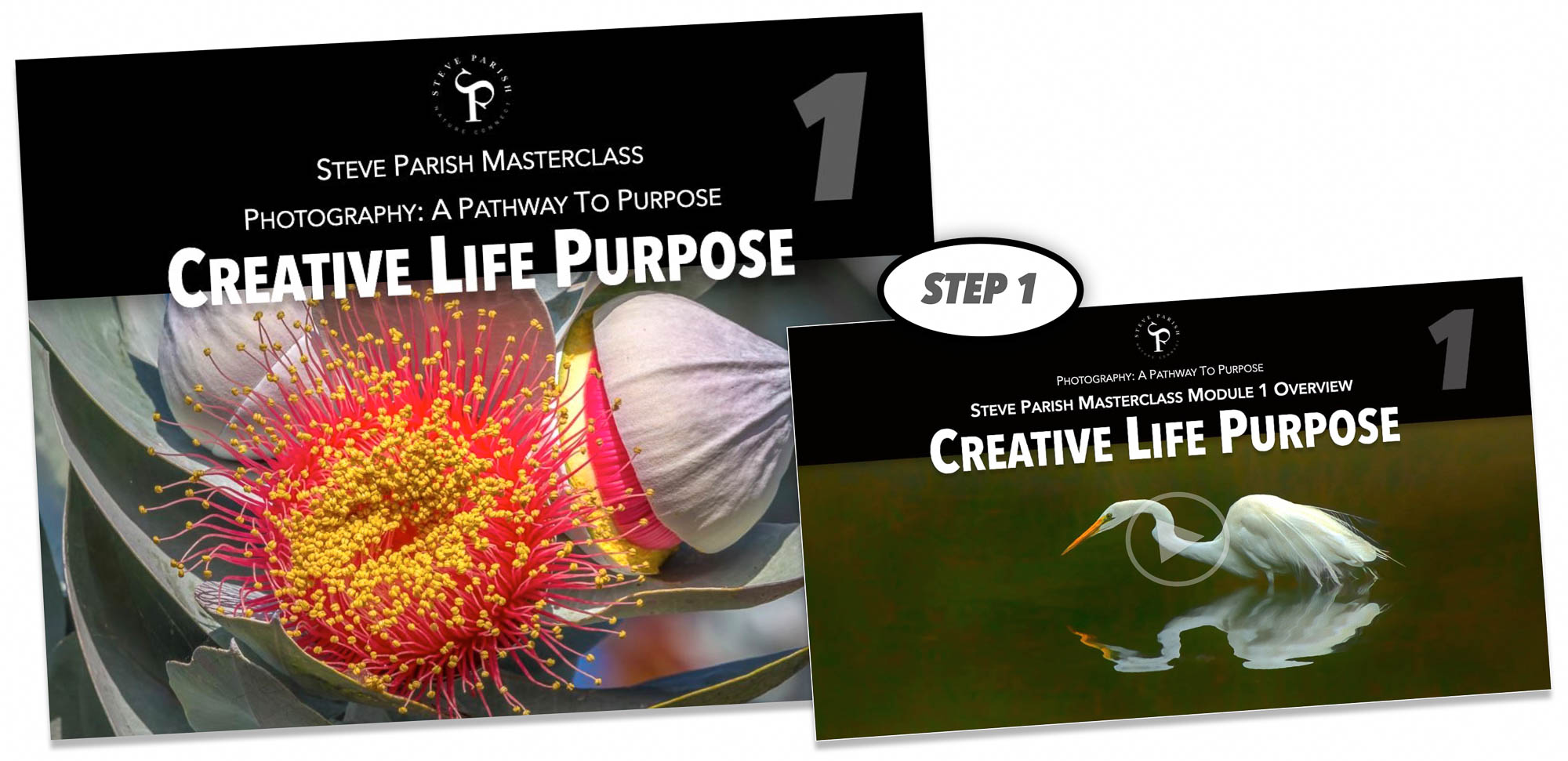
a vision statement as a guide for a creative life
Pivotal moments and opportunities come to all of us, yet recognising them when they arrive can be surprisingly difficult. In my Masterclass, Photography: a Pathway to Purpose, I encourage participants to develop a clear vision statement — one that acts as both a compass and a touchstone.
Looking back, many of my own pivotal opportunities would have come to fruition more easily had I been clearer, earlier, about what I valued most.
Before launching my publishing company in 1985, I wrote a simple statement:
“To inspire others to regard the natural world as essential to spiritual, mental, and physical wellbeing.”
That sentence has guided both my personal and professional life ever since. Whenever I’m faced with a decision, I return to it. It has never let me down.
The first module of my Masterclass focuses on developing what I call a creative life purpose statement. It’s not something to be written and forgotten, but a living guide — nourished daily and used, when necessary, as a kind of battering ram when obstacles arise. When a clear pathway isn’t evident, I suggest beginning with a simple inventory of values and assets. These often reveal more direction than we expect.
This approach has been warmly embraced by Masterclass members, many of whom now share their journeys within an emerging and supportive community. I also encourage participants to choose a single image as a visual anchor. Mine is a photograph of the spectacular mottlecah eucalypt flower (cover above) — a reminder of my Creative Life Purpose and of constant renewal. Each new bud reinforces the truth that everything in life is always changing.
Ten tips for recognising and seizing pivotal life moments
Recognising and acting on pivotal moments requires awareness, honesty, and a willingness to engage fully with life.
1. practise mindfulness
Stay present and attentive to your thoughts, emotions, and surroundings. Awareness sharpens perception.
2. clarify your values and goals
Knowing what truly matters makes opportunities easier to recognise.
3. stay open-minded
Pivotal moments often arrive unexpectedly. Flexibility allows them to unfold.
4. trust your intuition
Your instincts are often the first signal that something meaningful is happening.
5. embrace uncertainty
I’ve learned that when I feel too comfortable, I may be stagnating.
6. take considered risks
Growth usually requires stepping beyond familiar ground.
7. seek guidance and support
Mentors, friends, and family can offer clarity when perspective is clouded.
8. learn from setbacks
Every misstep carries information. Use it.
9. stay proactive
Curiosity and engagement invite opportunity.
10. acknowledge success
Pausing to recognise progress builds confidence and momentum.
By cultivating a clear vision and remaining attentive to life’s quiet signals, we become far better equipped to recognise — and act upon — the moments that shape a creative life.


The book ‘Exploration North’ was one of the inspirations that led me to an interest in nature andeventually turned into a long career in the Queensland and Tasmanian Parks and Wildlife Services spanning 40 years. My copy of this book fell apart many years ago and I have replaced it with another and now collect extra copies and draw animals on the title page and give them as gifts to mark special achievements of my colleagues. In the process of hunting for more copies I have picked up the copy that was inscribed ‘To Steve – with our thanks and congratulations’ and signed by the editor and authors. I bought it and have had it for a couple of years and I was wondering if you would like to buy it from me as it must mark the start of your career. Anyway, let me know. As to a price. I’ll leave that up to you. I would also be interested in finding out more about Nature connect as I have worked with environmental education teachers in the past delivering a program called ‘Nature exposes: Reconnecting people and nature. All the best.
Hi Tom, thanks for the feedback. I will respond re the book on email.