

Australian Natural History:
Possums & Gliders
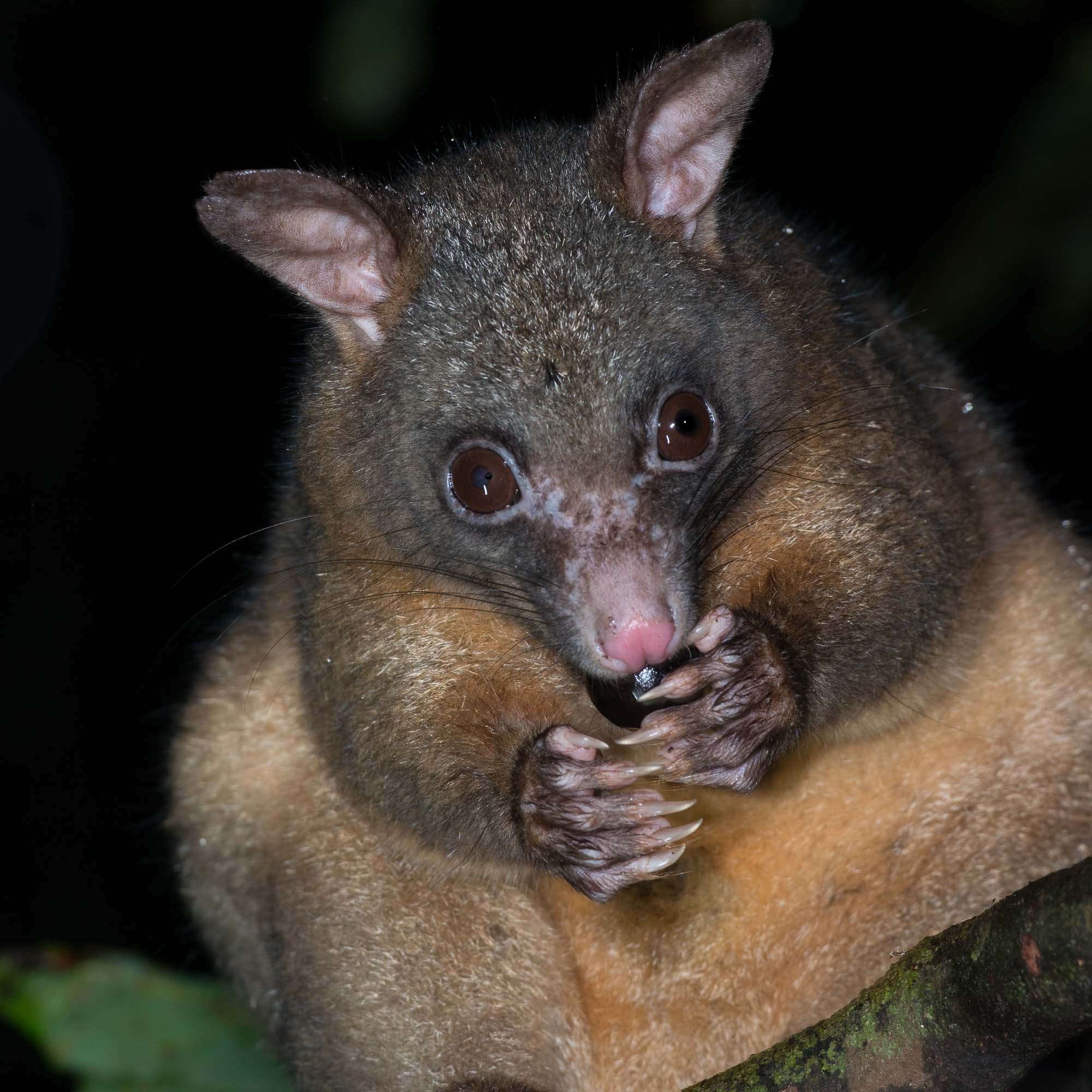
For some Australians, possums are not at the top of the popularity list when it comes to Australian wildlife. This is primarily due to the brush-tailed possum, the boldest, most wide-spread possum in Australia. This species is often found setting up residence in peoples roof spaces. These noisy by night creatures have probably damaged the reputation of the twenty-two others species most of which are unknown and undoubtedly unseen by most Australians. So, let’s throw some light on both the ‘guilty party’, the common brushtail possum, and examine some of its very special relatives.
First a little family Taxonomy
Pygmy-possums belong to the family Burramyidae, while the larger brushtail possums, cuscuses and Scaly-tailed Possum are members of the family Phalangeridae. Ringtail possums share some features with the large Greater Glider, which occupies the family Pseudocheiridae with them. The other gliders, known as wrist-winged gliders (such as the Sugar Glider) and the Striped and Leadbeater’s Possum are grouped in the family Petauridae, while the Honey Possum and Feathertail Glider are sole members of the families Tarsipedidae and Acrobatidae respectively. Some authorities disagree with the classification of some possum species into these separate families.

Indigenous & Early Naturalist Accounts
Francis Barralier, who attempted to cross the Blue Mountains in 1802, wrote that the possum was probably the most crucial protein source for inland Aborigines, and described them as people who “ascend the tallest tress after the opossum and flying squirrel”. The Adnyamathanha of South Australia also valued possums so much as a food source that a special “possum catching” song was performed to augur a successful hunt. Gould described how Aborigines caught these nimble phalangerids: “having discovered their retreat [they] cut a hole in the branch, fearlessly insert their hand in the hole, seize the animals by the tail, drag them forth, and despatch them by beating the head against the tree; when roasted the flesh is white and delicate, and not unlike that of a rabbit.”
Possums were important in Dreaming culture and Aborigines also used their thick pelts to make rugs, loinclothes, girdles and headbands. Possum fur rugs and cloaks were indispensible in the colder climes, particularly in South Australia among the peoples of the Murray River, Adelaide Plains and Coorong. Often they were constructed of possum and kangaroo skins stitched together with dried kangaroo sinews. Aranda men from the central deserts of Australia also wore a headband, known as a chilara, of string made from the fur of a wallaby or possum. They coated it with ochre and decorated it with geometric patterns indicative of country and culture. The fur of the Scaly-tailed Possum was also twisted into string.

A Personal Backstory
When I joined the Queensland National Parks and Wildlife Service (QNPWS) as a photographer in 1975, my first assignment was to photograph the Herbert River ringtail possum. The newly formed department had chosen the animal as their logo and required photographs. This species lives at high altitudes in the now World-Heritage-listed tropical rainforests west of Cairns and north into what is now Daintree National Park, Queensland. In the mid-1970s few areas were set aside as national parks, and the possums that inhabited rainforests in the north were to be used to monitor the management of the forests.
My guide was Dr John Winter, who had spent years studying possums in their natural habitats. We arrived in July and, from his home base in Atherton, Dr Winter and his assistant Rupert Russell made plans to catch and photograph these fast-moving, elusive marsupials. As a total amateur at both rainforest and nocturnal photography, I had no idea what I was in for! For a young man fresh from the waters of southern Australia there were few parallels. Once again, what I lacked in the knowledge I made up for in enthusiasm.
We set out each misty evening in a battered Landrover with John sitting on the roof and Rupert riding the tailgate. Powerful spotlights pierced the night sky and painted the limbs of tall trees with light, to reveal the possums’ eye-shine. I could hear John and Rupert discussing each possum they saw and whether it would be possible to trap it for close-up photography. The men were also busily determining species, as possums other than the Herbert River ringtail were also to be photographed. Before long, green ringtail and lemuroid ringtail possums were seen, brought down in nets, quickly photographed on low branches, then released. At around 11 pm, a large male Herbert River ringtail was sighted. These beautifully marked animals are easily identified by their black fur and a white underbelly. Identifiable, yes — but not so easily captured and handled!
On subsequent nights we also photographed the copper colour form of the common brushtail possum and a greater glider in the woodland surrounding the rainforests. That week in the forest had a motivating effect on me. It brought into focus the enormous task I had in front of me, photographing these magnificent mammals and the habitats that supported them.


Locomotion and Climbing
Most possum species navigate the treetops in a crossed extension walk, alternating the hind- and forelimbs, but change their gait to a bound to move more quickly. The Striped Possum’s typical gait is a little different. It moves a diagonal forelimb and hindlimb forward together too, but in what has been described as a “rowing” motion. Climbing is achieved by moving the two forefeet forwards first and then the hindfeet, to ascend a tree trunk. When leaving a tree, possums descend headfirst, gripping with the front paws and then the back, but they are capable of bounding quickly once on the ground.
Several species, most notably pseudocheirids and pgymy-possums (above top right), use their long, prehensile tails to cling to branches of vegetation. While all species are capable of leaping some distance from one branch to another, several of the pseudocheirids, particularly the rainforest species such as the Green Ringtail, are deliberate and cautious in the treetops and prefer to come to ground rather than make lengthy jumps. Common brushtails are extremely adept in moving about in the treetops (above left and right). Gliders, (above top left) of course, do not have that problem, being capable of gliding 30 m downwards through the forest.

Possum Senses
Possums have excellent senses of sight, smell, hearing, and touch. A pigmented, highly reflective layer in the eye, known as the tapetum lucidum, assists visual acuity in low lighting, and whiskers on the snout, head, and limbs provide tactile sensory assistance.
Most communication is through vocalisations and scent marking, so hearing and smell are vital. A cartilaginous chamber in the larynx may act as a resonator to help project vocalisations in brushtail possum species.
Most possums rely on their olfactory senses and possess anal glands that secrete a sticky, odoriferous creamy-coloured fluid that is also present in the urine and probably aids communication for reproductive and social purposes. Urine dribbling, combined with sternal and paracloacal gland rubbing, leaves smelly “notices” for others and secretions are even produced from as many as eight glands in the body of pygmy-possums. Some species also sniff each other’s faces, and males sniff females’ cloacas when they enter oestrus.


Building a nest
Most possums and gliders retreat to a nest by day, so nest building is generally not associated with the birth of young or cessation of pouch life but more with the general need for diurnal shelter. Nests or dreys may be in tree-growing ferns, in tree hollows or in vegetation or foliage and while subadult, suckling young can remain in a nest they may also accompany their mother, riding piggyback.

Pouched young and juveniles
Maternal size and litter size dictate the length of pouch life and weaning. Females of small species that commonly give birth to more than two joeys in a litter have a shorter maternal investment in pouch life and weaning. As a result, pygmy-possum offspring grow more rapidly than the young of larger possums and gliders and are weaned sooner, and Honey Possum joeys remain in the pouch for just two months. Larger species that give birth to a single joey have a longer pouch life and females lactate for longer. Greater Glider joeys have the longest pouch life.
Some species have high mortality of pouch young, particularly Leadbeater’s Possum, and almost 50% of Sugar Glider pouch young may also die in poor seasons.

In our own backyard
One of the biggest areas of conservation for possum is actually in our own backyards. Short-eared Brushtail Possums, Sugar Gliders, Common Ringtails and Common Brushtails have adapted to city life, where they face staunch opposition from home and business owners tired of their clamorous antics in ceilings and their destructive habits in the garden. While it is tempting to have these marsupial squatters removed, possums are protected in all Australian States and strict legislation governs their removal from even architectural den sites. Extensive studies have shown that the majority of relocated possums die shortly after being moved. For this reason, a better option is to encourage these nocturnal guests out of houses and into specially designed nest boxes in backyards or nearby woodlands, then close up entrance points.

Saving the snow lover
The Mountain Pygmy-possum was believed to have become extinct some 15,000 years ago — until one was discovered hiding in a ski hut in the Victorian Alps in 1966. This small marsupial is still very vulnerable to extinction because of its specialist habitat requirements in Australia’s freezing alpine regions. Among marsupials, it is one of the few species known to save and store food, such as seeds, for later, but is also largely dependent on the Bogong Moth, which it feasts on prior to its annual hibernation. Females of this species construct a nest-like dwelling in boulder banks above the alpine snow line, which is snow-covered for seven months of the year. Males occupy habitat further down the alpine slopes, leaving the female prime habitat. It is essential that the two are able to move from higher to lower ground seasonally to mate, but climate change could reduce snow cover and further restrict the range of this endangered marsupial.
Above: The Mountain Pygmy-possum is the only Australian mammal to dwell year-round above the snowline; Recovery programs and a captive-breeding program at Healesville Sanctuary, Victoria, aim to safeguard this species.

Possums in care
Urban possums are also regular victims on our roads and pouch young frequently perish along with their mothers on Australia’s highways and byways. Rescued joeys require round the clock care but may become too dependent for re-release into the wild. Rope bridges strung from canopy to canopy above roadways or underground tunnel beneath roadways can help these and other marsupials cross safely. Across Australia there are many hundreds of wildlife carers, some specialise only caring for possums.
Meet Nine Special Possums

Striped Possum
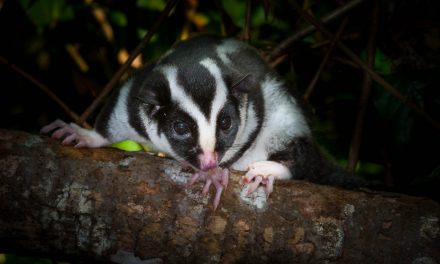
Although one of the most flamboyant possum species in appearance, the dramatically marked Striped Possum is rather a secretive marsupial and is rarely seen. Agile and elusive, it moves rapidly and erratically through the rainforest canopy at night, searching for insects and their larvae, which are exposed from beneath bark and inside decaying wood.
Dwelling in the rainforests of New Guinea, Indonesia, and Tropical North Queensland, it is also found in lowland adjoining open woodlands from Cape York down to Townsville. Striped Possums must maintain a sizable home range to provide them with the space to hunt for insects and native fruit, which become less plentiful in the tropical dry season.
This clever dietary specialist pries into bore holes or rotting wood to extract insects using its long fourth finger — an adaptation similar to that of the unrelated Madagascan Aye-aye. Fruit, ants, termites and plant exudates are also eaten.

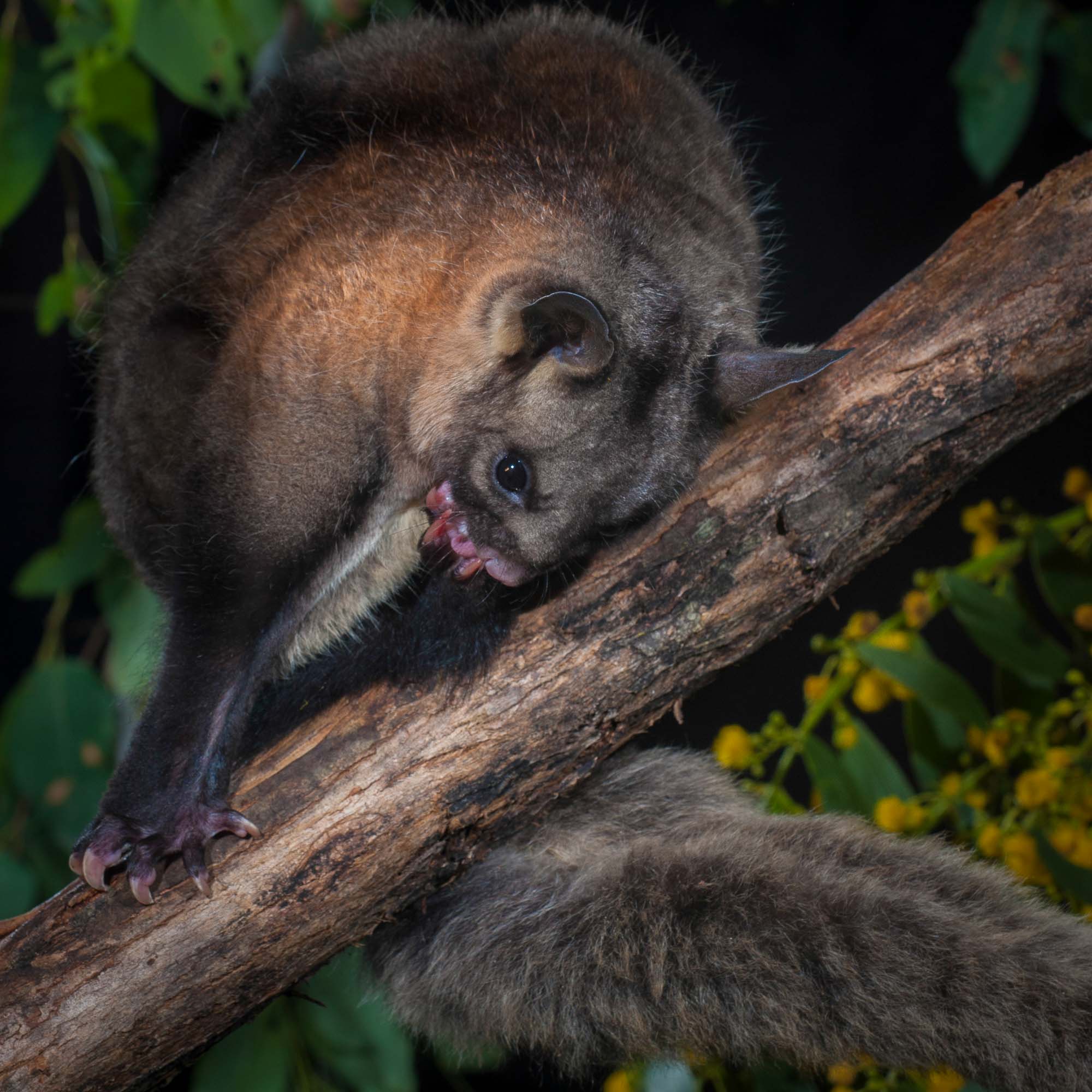
Yellow-bellied Glider
The largest species in the Petauridae family, weighing a maximum of 700 g, the Yellow-bellied Glider dwells only in the continent’s coastal wet eucalypt forests along the east coast from north Queensland to western Victoria. The genus name Petaurus translates roughly as “rope dancer” or “tightrope walker” and this species’ habit of dangling from its prehensile tail, nimbly navigating slim branches, or running along the underside of a branch makes it an apt moniker.
Prime Yellow-bellied Glider habitat is open and wet sclerophyll forests along the continent’s east coast ranging south to the SA border, although some populations also inhabit high-altitude rainforest to the north-west of Cairns, Qld, and may be genetically distinct.
For an animal that survives on gum exudates, the Yellow-bellied Glider’s size means it must forage for much of the night (as much as 90% of its night-time duties) to gain enough energy to survive. Using their chisel-like incisors, Yellow-bellied Gliders gnaw grooves into the bark of Eucalyptus or Banksia
species and suck at the sap exuded. In north Qld populations, Bloodwood trees are a favoured source of food. While they dine on just a few species, they obtain their protein requirements from insects beneath the bark and also consume manna, honeydew and pollen.
By day these gliding possums conserve energy by retiring to a nest in a tree hollow. Less than an hour after sunset, they emerge to forage, returning to the drey just before dawn. Like the Sugar Gliders, they are gregarious and live in communal groups made up of a dominant male with one or more females and their subadult offspring.

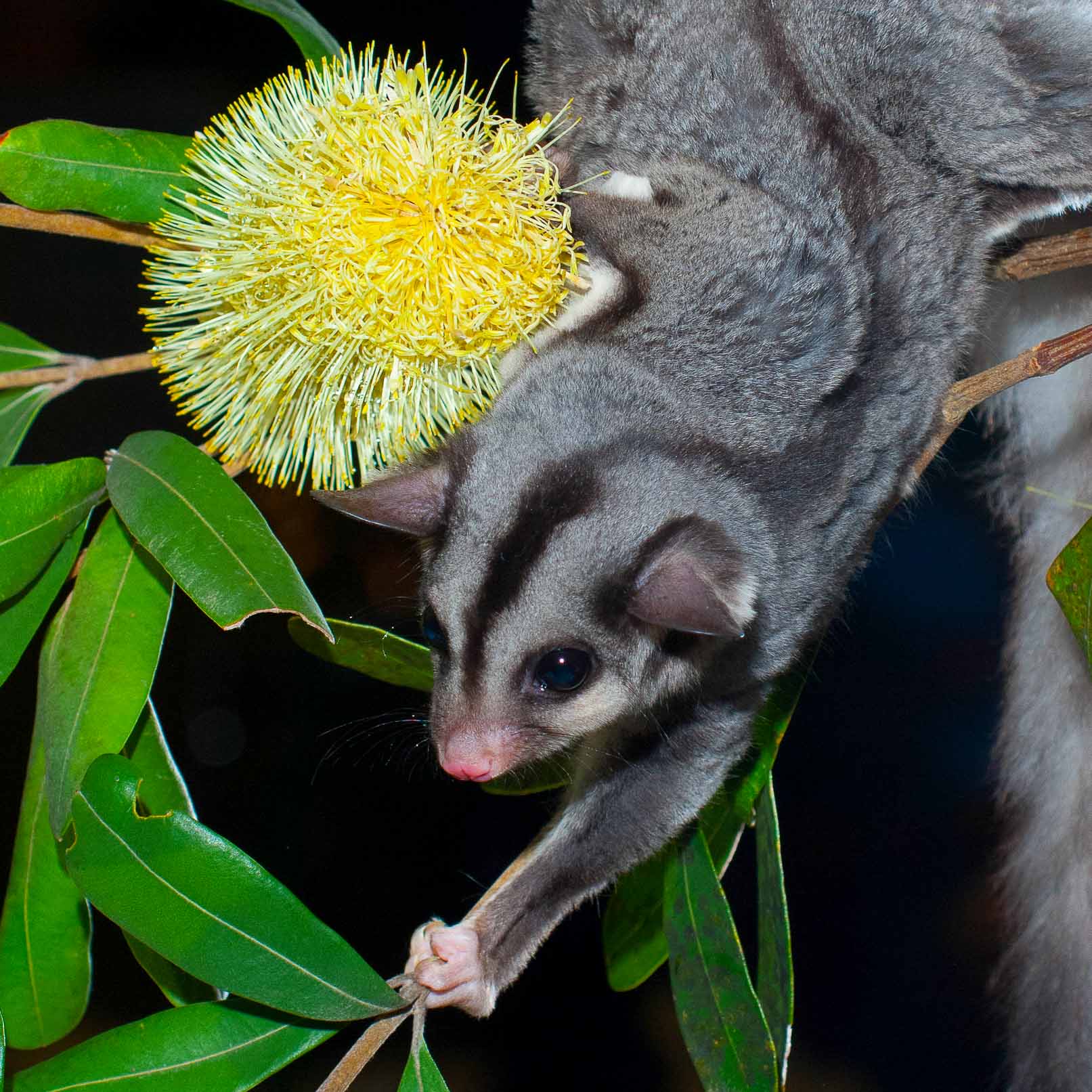
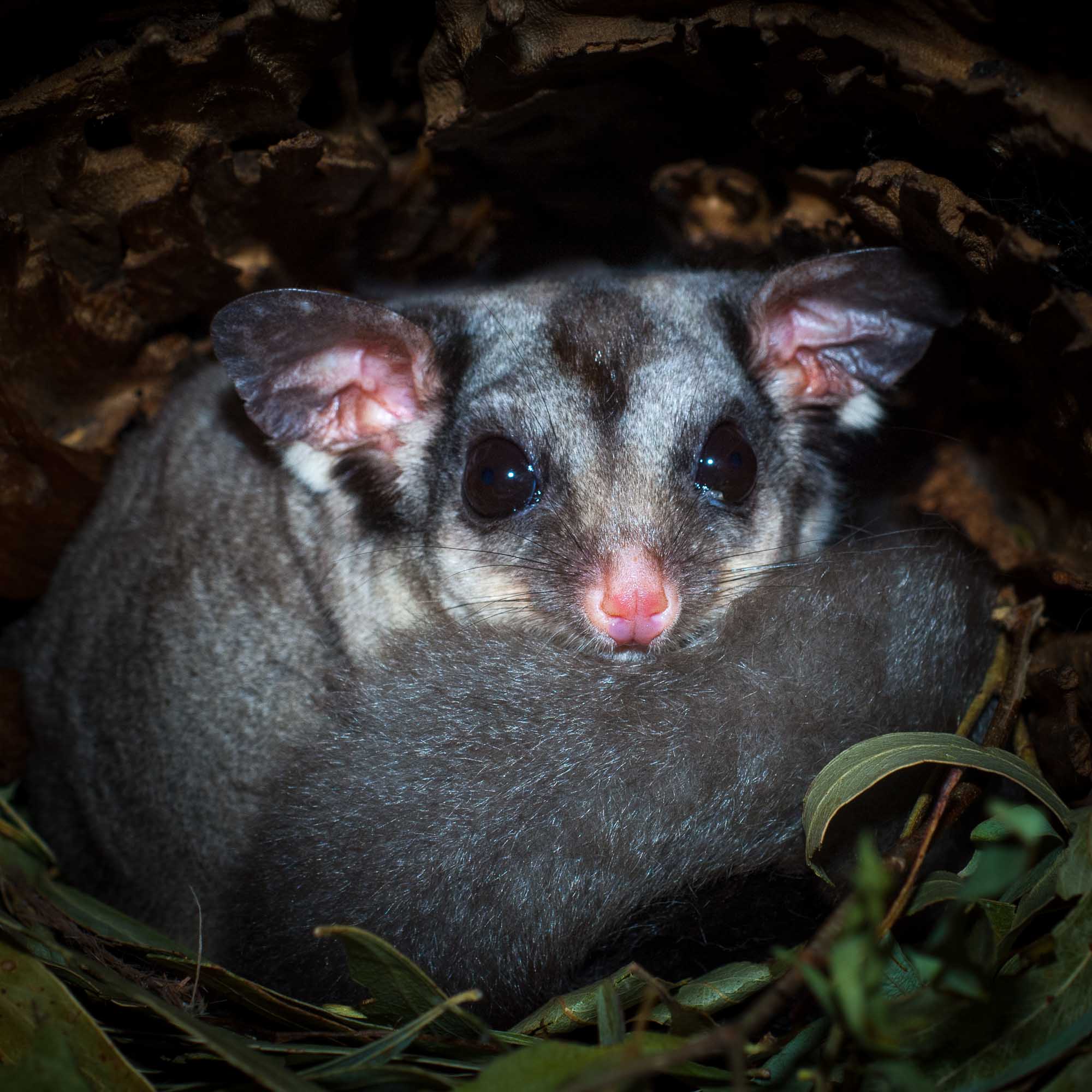
Squirrel Glider
The species epithet norfolcensis came from the incorrect belief that this species inhabited Norfolk Island, which it does not. The error came about because the original specimen was procured by a member from the ship Supply, after its return from Norfolk Island. Gliding as much as 80 m in a single glide, the Squirrel Glider resembles a larger version of the more widely distributed Sugar Glider. Its fur was highly prized in the early days of European colonisation and Gould wrote that the Aborigines sometimes gave it to the colonists “who occasionally apply it to the same purposes as those to which the fur of the Chinchilla and other animals is applied in Europe, — the trimming of dresses, boas, &c.”
Squirrel Gliders inhabit eastern Australian hinterland and coastal dry eucalypt woodlands and forests, particularly those vegetated with Eucalyptus, Corymbia and Angophora
species along the Great Dividing Range from Bordertown, SA, to Cape York Peninsula, Qld. They are also found in the hinterland and frequent River Red Gum and Yellow Box woodlands in the Murray Darling Basin. Although their range does not extend into Tasmania, the Northern Territory or Western Australia (as the Sugar Glider’s does), they shares habitat with the Sugar Glider within their range and have a similar diet and social structure. Sugar Gliders are probably displaced by this larger species when they occur sympatrically. Home ranges vary from 1.4–2.8 ha, but much of their habitat is patchily distributed on pastoral properties or on roadside verges, although some is contained within national parks. Plenty of tree hollows and winter-blooming shrubs are necessary environmental elements for this endearing gliding possum.
The Squirrel Glider is a dietary generalist, but still prefers pollen and nectar when they are widely available. Its nutritional needs are also met by plant exudates and sap, honeydew, manna and invertebrates, and season and availability dictates the major components of its diet. Water turnover is relatively high in Sugar and Squirrel Gliders due to the sugar solutions in gum and nectar and in water intake from dew.
Squirrel Gliders form social groups of several adults and their offspring, dominated by a breeding pair. They make communal, leaf-lined dreys in tree hollows, using several different hollows in a region and moving between them regularly. One tracked study in Victoria recorded two adult pairs using 19 different hollows over a 40-day period.

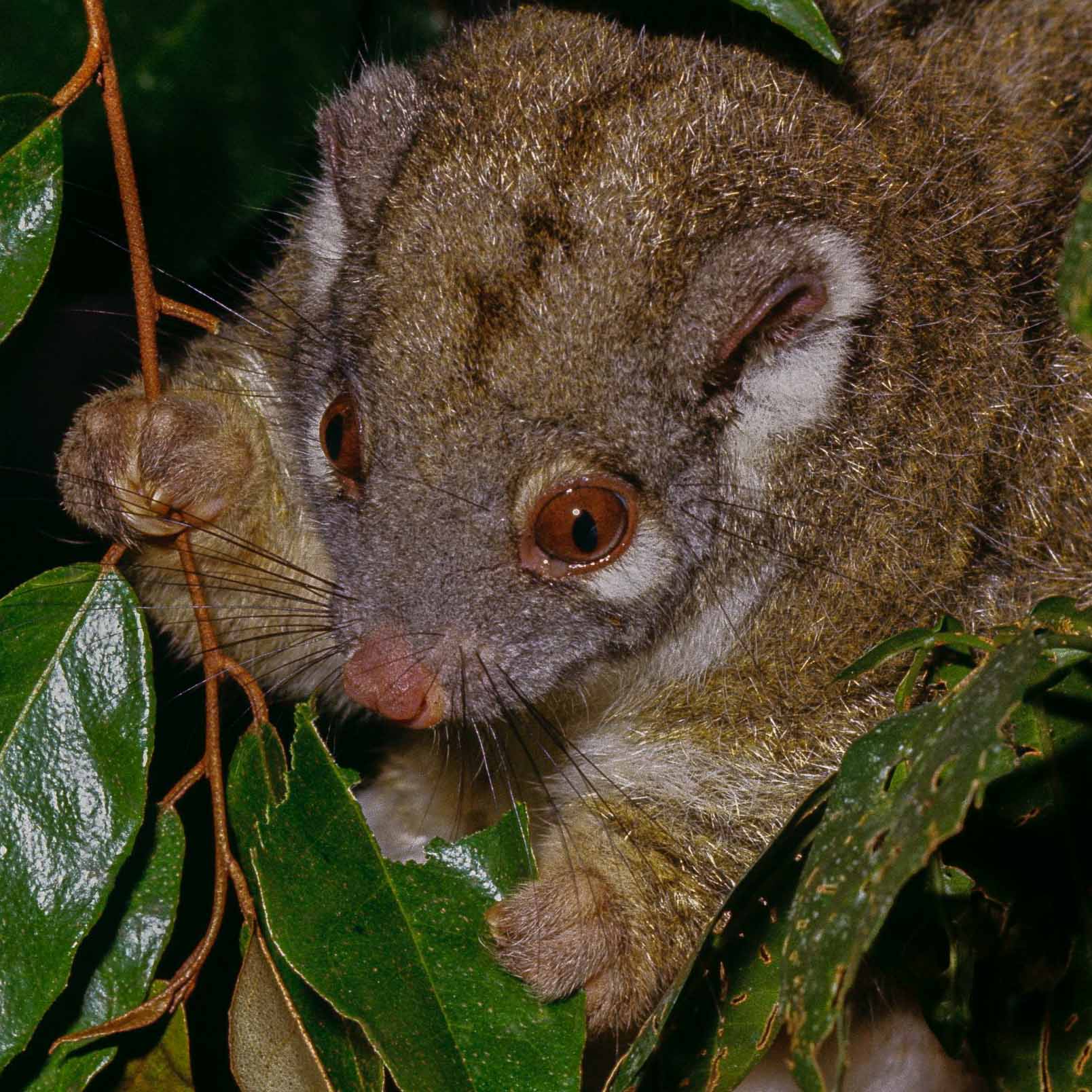
Green Ringtail Possum
Specimens of the endemic Green Ringtail Possum, which makes its home in upland rainforest between Paluma and the Mount Windsor Tableland in Queensland, were first collected by naturalist Carl Lumholtz in 1883 after being brought to his attention by local Aborigines. It is uncommon in foregoing the use of a den or drey; instead using its mottled green colouring (made up of a blend of black, yellow and white guard hairs) as camouflage on mossy branches.
This species is associated with high-altitude rainforest growing on basalt rock from 800–1200 m above sea level and is less common below 300 m sea level.
Leaves and fruit nourish this species, which is especially fond of fig leaves (Ficus spp.). Green Ringtails can also consume the leaves of the noxious Shining-leafed Stinging Tree and othe Green Nightshade, which is toxic to humans. Enlarged salivary glands might help neutralise toxins in these plants. While the Green Possum is equipped with a small caecum, it is probable that microbacterial digestion occurs in its extended colon. It has been seen engaging in coprophagy, despite digestive adaptations that would seem to make eating faecal pellets unnecessary.
Coming to ground rarely, only when moving to new habitat, this possum prefers to be high in the treetops where it uses vines to assist it in moving from branch to branch, rather than jumping. Green Possums are reclusive and solitary. They are rarely seen in pairs (aside from mothers with dependent young) and males and females most likely come together only to mate.

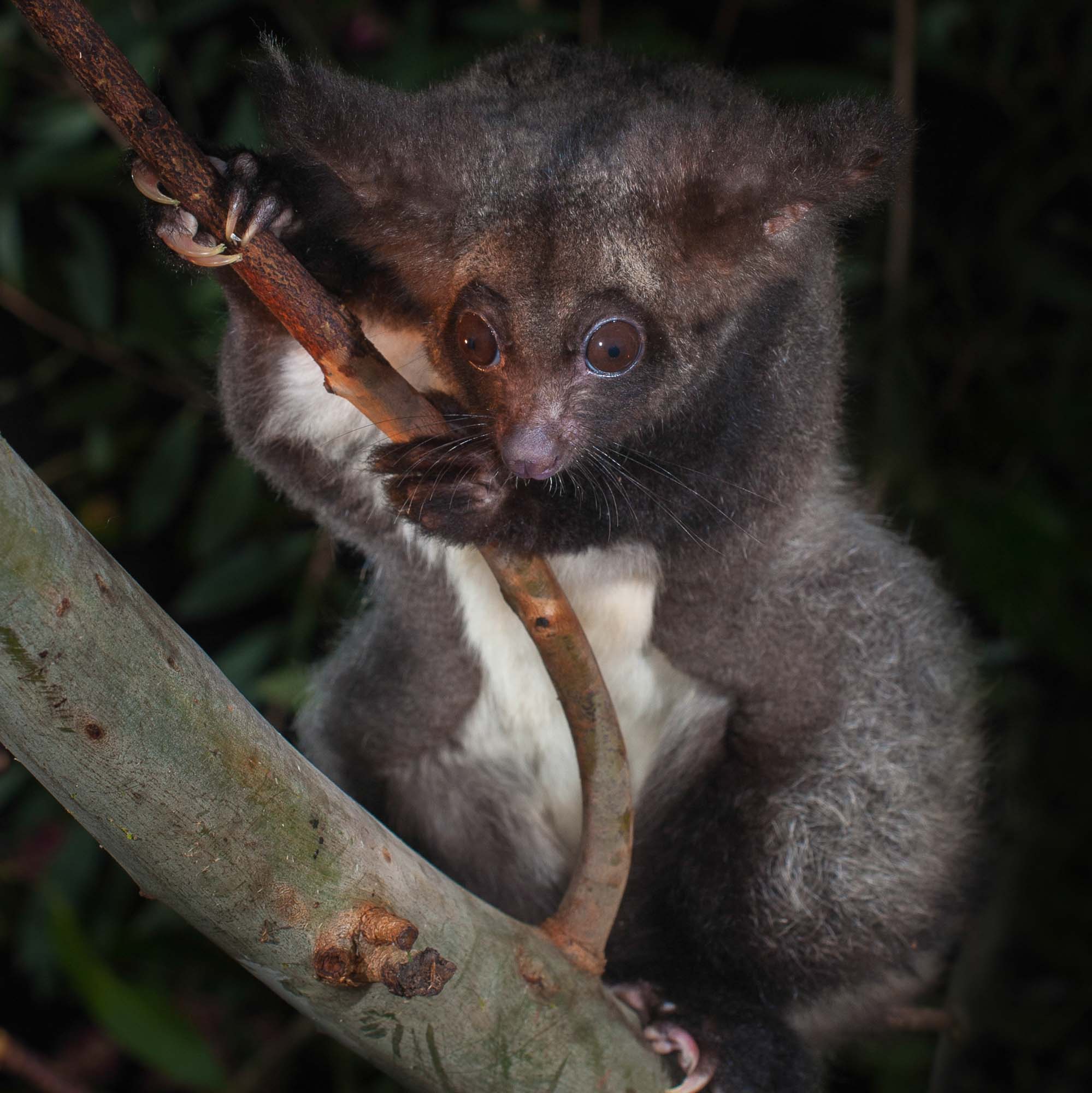
Herbert River Ringtail Possum
Collett first described this distinctive possum in 1884 after it was brought to scientific attention by Carl Lumholtz. It prefers rainforest at altitudes of 800 m or more on basalt soils in the Wet Tropics but is sometimes seen at altitudes down to 350 m and in adjoining eucalypt forests. The dissecting Herbert River Gorge fragments its habitat, creating two distinct populations.
It occupies luxuriant rainforest close to the source of the Herbert River, but is also found at Lamb Range and Mount Lee, west of the town of Ingham, Qld.
High-protein leaves of numerous rainforest trees, including Pink Ash, quandong and satinash species comprise as much as 88% of its diet, but it also relies on fruit and blossoms.
This solitary possum is nocturnal, leaving the den shortly after dusk and then grooming before foraging and returning to the drey hours before dawn. Even its nest is in the treetops, either in an epiphytic fern or in a clump of orchids. In cold weather or during a full moon it spends less time out of the nest and may emerge from the drey earlier on overcast days. Home ranges of both sexes overlap but are rather small, at just 0.5 to 1 ha.

Common Ringtail Possum
The Common Ringtail Possum is, as its name suggests, a widely distributed species familiar to many along the continent’s eastern seaboard. There are several recognised subspecies (Pseudocheirus peregrinus peregrinus, P. p. convolutor, P. p. pulcher and P. p. cooki) and it is likely that this actually represents a species complex.
Features: This mostly ginger-coloured possum has a distinctive white patch behind the ears. The sparsely furred, white-tipped tail with a naked strip on the underside helps it cling to branches.
Habitat & Distribution: Common Ringtails dwell in dreys or nests of bark and twigs situated about 4–5 m above the ground in eucalypt forests, rainforests and riverine woodland in all Australian States excluding WA and NT. Each individual maintains several dreys and moves between them on their nightly sojourns.
Diet: They are efficient at processing their low-nutrient vegetarian diet. After consuming flowers, buds and leaves, they pass them out in the drey as a pellet-like poo known as a caecotroph. The caecotroph is then eaten, extracting every ounce of nutrition out of their diet. Rosebuds are especially relished and they also raid backyard gardens and orchards.
Lifestyle: Night-active, the Common Ringtail Possum leaves the drey early in the evening and grooms and forages before returning to its den shortly before dawn. It is gregarious, living in small family groups that feed and sleep together. Pairs are monogamous and may remain pair-bonded for more than one breeding season, although a male’s home range usually overlaps that of two females and once young are born the male may impregnate a second female.

Feathertail Glider
“This pretty little animal, the ‘Opossum Mouse’ of the colonists, is very common in every part of New south Wales; but from its nocturnal habitats, its small size, and from the circumstance of its exclusively inhabiting he hollow limbs of the larger gum trees, it rarely comes under the observation of ordinary travellers…” wrote Gould, an observation that is mostly true today.
Mosaic or mixed woodlands and forest habitats appeal to the Feathertail Glider. Home ranges are larger for males (up to 2 ha) than for females (about 0.5 ha).
They must feed nightly to meet their exacting energy requirements and Banksia and Eucalyptus
blossoms are preferred, although they also dine on fungus, insects and moths, honeydew, manna and sap exuded from wedges made in bark by larger sap-eating marsupials.
By day they rest communally in nests made of leaves, in old bird’s nests, in dry vegetation or even in telephone junction boxes. In cold weather as many as 8 may huddle together for warmth—mostly females and their juveniles with one male, but at other times they sleep alone. When they huddle, one may lie over the top of the snuggling mass. They are also able to enter torpor, during which their breathing rate decreases (they may even take a breath only every 12 minutes) and their metabolic rates decreases to just 1% of their standard metabolic rate.

Common Spotted Cuscus
Sometimes called the Spotted Phalanger (and once sharing this genus name) these big-eyed, arboreal creatures were mistaken for monkeys in the early days of European settlement. First described in 1818, this is the largest Australian possum and is really a subspecies (Spilocuscus maculatus nudicaudatus) of a New Guinean cuscus. Three other subspecies exist in New Guinea and the Moluccas.
Found in rainforest on Cape York north of Bowen, Qld, the Common Spotted Cuscus inhabits rainforest, mangrove and gallery forests and reaches its highest altitudes on the McIlwraith Range. It also occurs in paperbarks that fringe riparian forest close to rainforest.
This species forages in the treetops, dining on rainforest fruit such as that of the Leichhardt Tree and figs, as well as flowers and leaves. Captive individuals also eat meat and, as their dentition suggests, they are likely opportunistically omnivorous in the wild.
They do not rely on tree hollows, instead sleeping on a branch or concealed by foliage in the canopy, where they may fashion twigs and leaves into a simple nest. Radio-tracking studies suggest they come to ground to move between patches of habitat and change sleeping trees daily. Believed to be largely solitary, pairs probably come together only to breed.


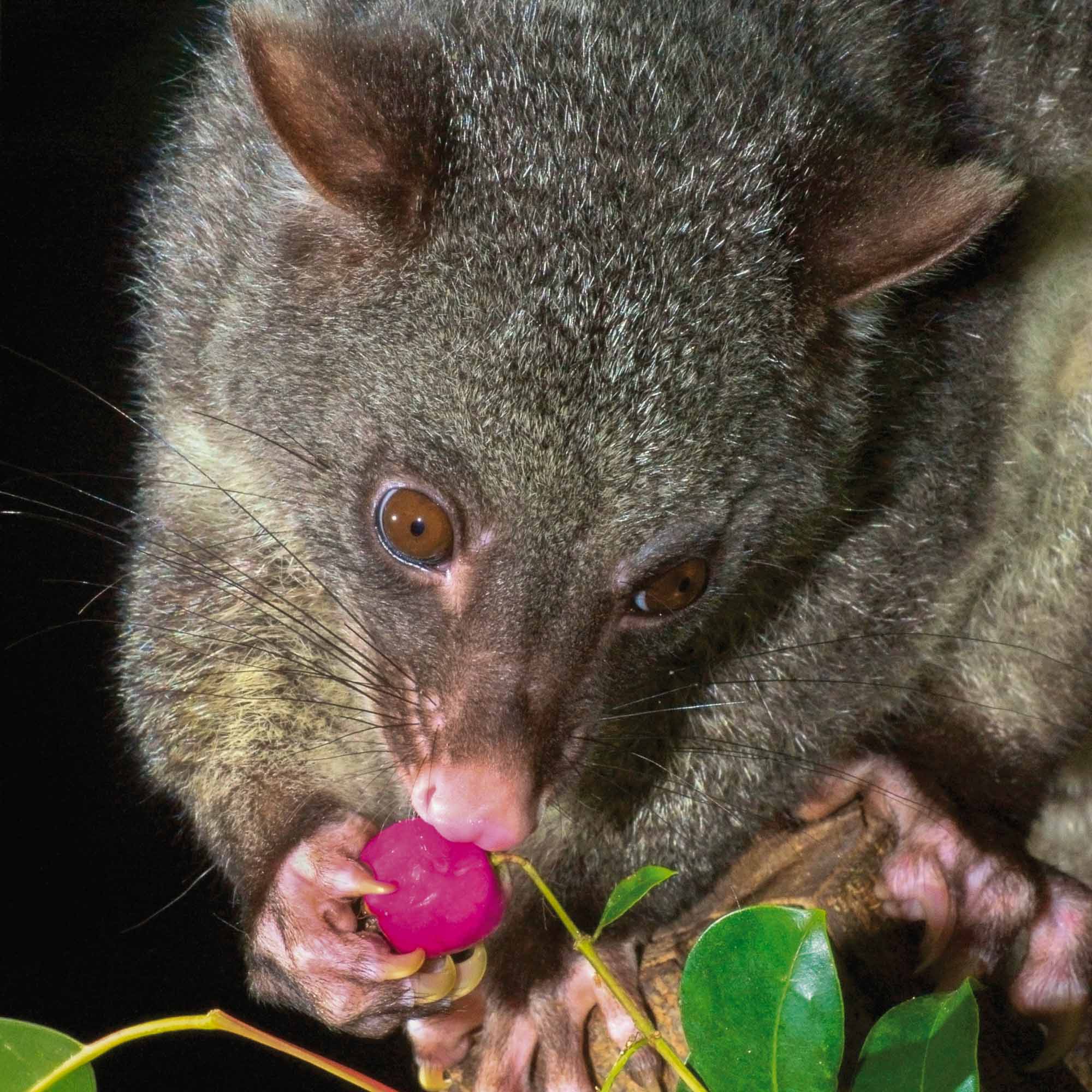
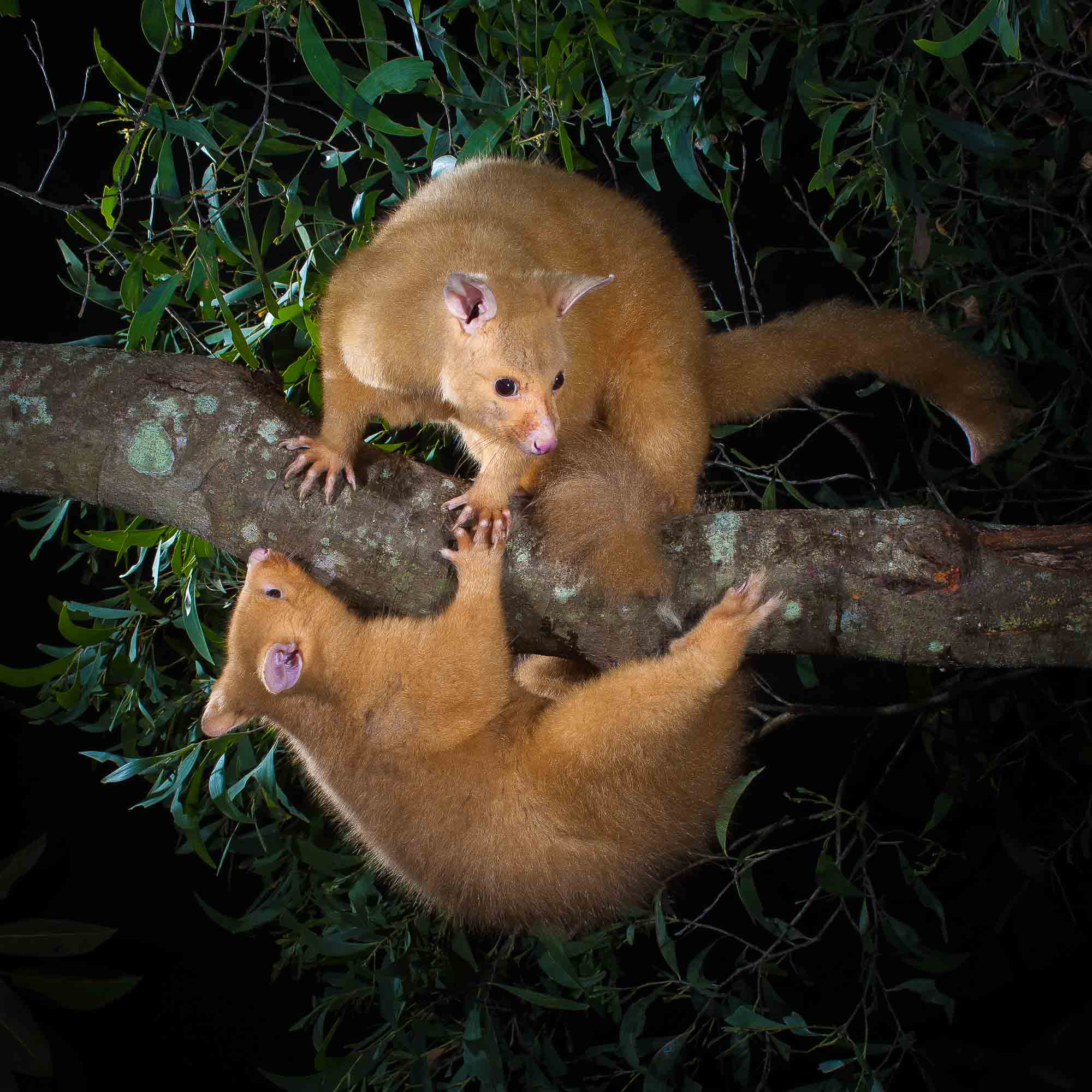
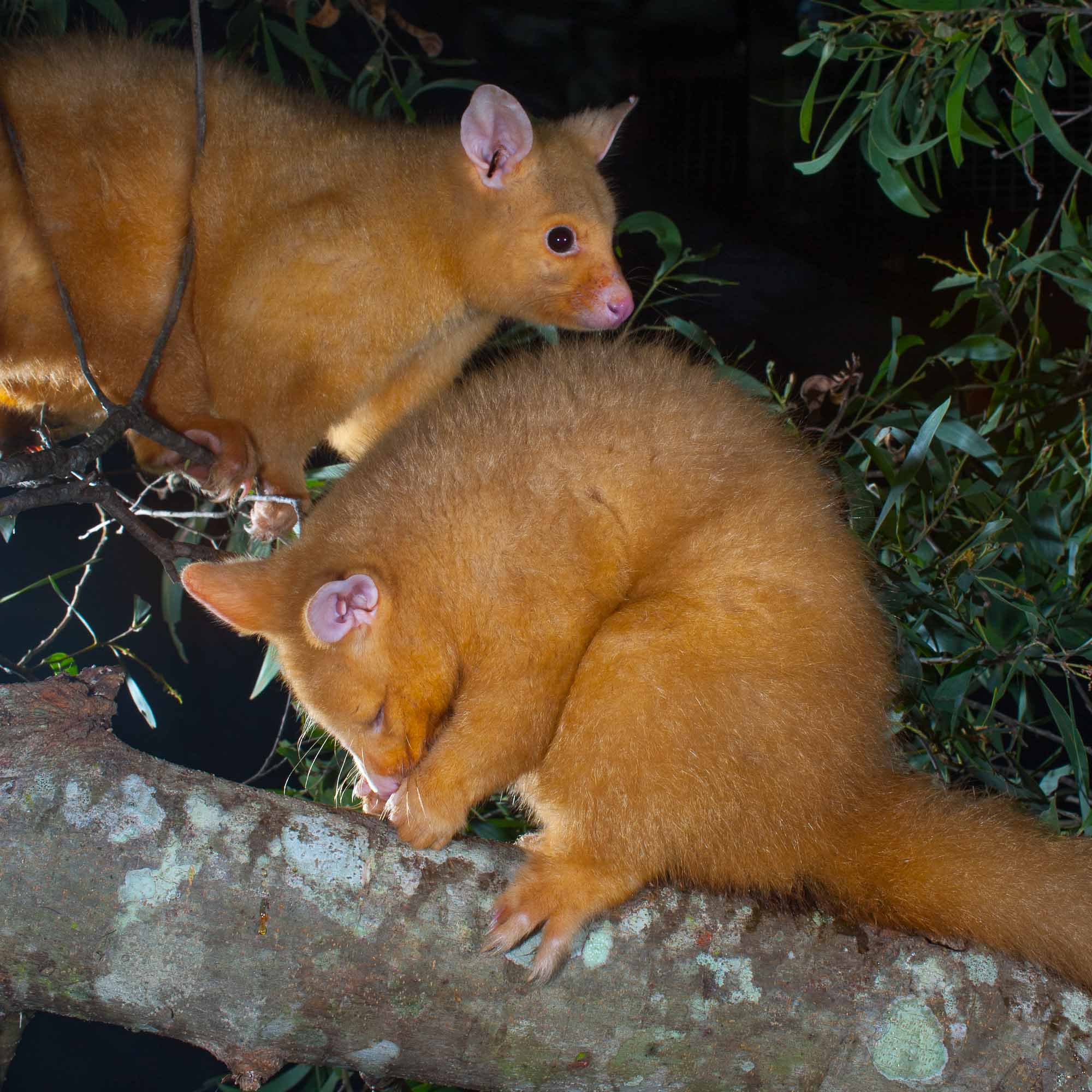
Brushtail Possum
“During my travels in Australia no living mammal was more frequently presented to my notice and no one was more often brought by the natives to the camp-fire for the purpose of eating,” wrote Gould in 1863. Krefft also commented that “this species is the staff of life to the natives”. It is, even now, extremely common indeed and is found in all Australia States. This resilient little phalangerid has managed to colonise even the most dangerous habitat — the concrete jungle of Australia’s urban streets. For this reason, many Australians have a love–hate relationship with this possum, which happily makes its home in ceilings and pilfers fruit and vegetables from backyard plots. Even so, its distribution has decreased significantly since pre-European settlement, when it lived across most of the continent, even the arid interior.
Dry sclerophyll habitat and woodlands are its optimal habitat, although it is a generalist when it comes to living spaces and makes good use of tropical woodlands, mountainous higher-altitude forests and even urban habitat.
Brushtails feast on vegetables, fruit trees, roses and other backyard blooms. Meat is also consumed, although they probably rarely engage in carnivory if fruit and blossoms are plentiful in the wild. They are also able to eat and digest plants that are toxic to many other species, including some eucalypts, the 1080-containing Gastrolobium species found in Western Australia, and the Cooktown Ironwood.
LIn less dense populations individuals have larger home ranges. This possum is not particularly fussy when it comes to drey sites and will sleep in a hollow tree trunk, log or branch, squeeze into gaps in rock piles or into small caves and cavities in rocks, enter abandoned termite mounds and nest in roofs, nest boxes and even hanging pot plants.
Above left: A cream-coloured form, found mostly in Tasmania is the result of a genetic mutation, rather than a subspecies colour phase.
Centre: Among possums, the Common Brushtail Possum’s morse commonly seen colour form.
Right: In the north, on the Atherton Tableland, the subspecies T. v. johnstonii has a coppery colour form. Tropical species, such as T. v. johnstoni and T. v. arnhemensis are more sparsely furred and are considerably smaller — weighing just 1 kg, a third of the size they grow to in Tasmania.
Possum gallery – click and scroll




Thank-you Steve 🙏🏼 all the best from Beth
Thanks Beth, I appreciate the feedback.