

Natural History:
Australia’s Parrots
Photography Steve Parish – Text Karin Cox
More than 330 parrot species inhabit our planet, and Australia is home to about 56 of them. In fact, this continent’s abundance of these birds led mapmakers of the 1500s to annotate the coast of a great southern land with Psittacorum Region — “The Region of Parrots” — as reported by Portuguese sailing expeditions. Australian parrots all belong to the Psittaciformes order, within which birds can be divided into three families. Cockatoos, in the Cacatuidae family, are the largest, and DNA studies have shown them to be genetically distinct from other parrots. Solid bodies, powerful grasping claws and well-defined, movable crests characterise them. By far the majority of Australian parrots (up to 60% of Australia’s species) belong to the Psittacidae family of “typical parrots”. Lorikeets, in the Loriidae subfamily, exhibit several biological differences that distinguish them from their Psittacidae relatives.
Above: The Torquise parrot prefers open, grassy woodlands with dead trees near permanent water. They forage on or near the ground for seeds of grasses and shrubs, flowers, nectar, fruits, leaves, and scale insects. They make soft, metallic-sounding notes in flight and high-pitched, weak, twittering sounds while roosting or feeding. The species nests in vertical or near-vertical hollows in living or dead trees, laying between two to five eggs. The Turquoise Parrot was considered extinct in the wild by 1917 but has since recovered in the Cumberland region of outer Sydney and Southern Highlands areas. Available as a fine art print.


Beaks and toes
As specialist nectar-eaters, lorikeets have modified tongues with long papillae that create a brush-like texture to soak up the sugary nectar and pollen. Defining features of all parrots are their strong, deeply down-curved bills. The upper mandible moves while the lower mandible is fitted neatly within the closed bill and has less movement. This oral structure allows parrots to manipulate seeds in the mouth, using the upper beak and flexible tongue, while holding the nut casing firmly in the bottom jaw — sometimes with the help of their deft claws. Parrots’ feet are also characteristic of this group of birds. The “zygodactylous” arrangement of toes — two pointing forwards and two pointing backwards — bestows parrots with relatively nimble movement in the treetops. All the toes terminate in long, sharply curved claws, which give parrots an extremely strong grip for clinging and clambering up tree trunks and grasping slippery nuts and seedpods. This combination of beak and toe arrangement is unique to the Psittaciformes order. Like the feathers of all birds, a parrot’s feathers are made up of a protein called keratin, which is the same substance that forms human hair and fingernails.
Above left to right: A corella feeding on speargrass seeds wraps its toes around a sheath of grass to support its weight while feeding on the seeds and two galahs repeatedly returned to a tree outside my home for three years until they had successfully dig out a hollow to create a nest. The birds returned for several years to raise their young.


A day in the life of a parrot
Parrots follow a well-established day-today routine. Unlike some other bird species, they require water daily and usually flock to waterholes at dawn, where they drink, bathe and preen. “Breakfast” follows and the flock moves to feeding grounds a few kilometres away from watering places. Most species forage in two daily sessions, retiring mid-morning to the shelter of the treetops to wait out the hottest part of the day, then flying in to feed again in the cool of the afternoon. Parrots are diurnal (day-active birds). By night they roost communally in the treetops, often visiting the waterhole again at dusk before settling to their roost.
Top left and clockwise: crimson rosella feeding on a nectar-rich grevillea flower; a musk lorikeet feeds on seeds; crimson rosella feeding on nectar and a black cockatoo feeds on nuts.

Diet and lifestyle
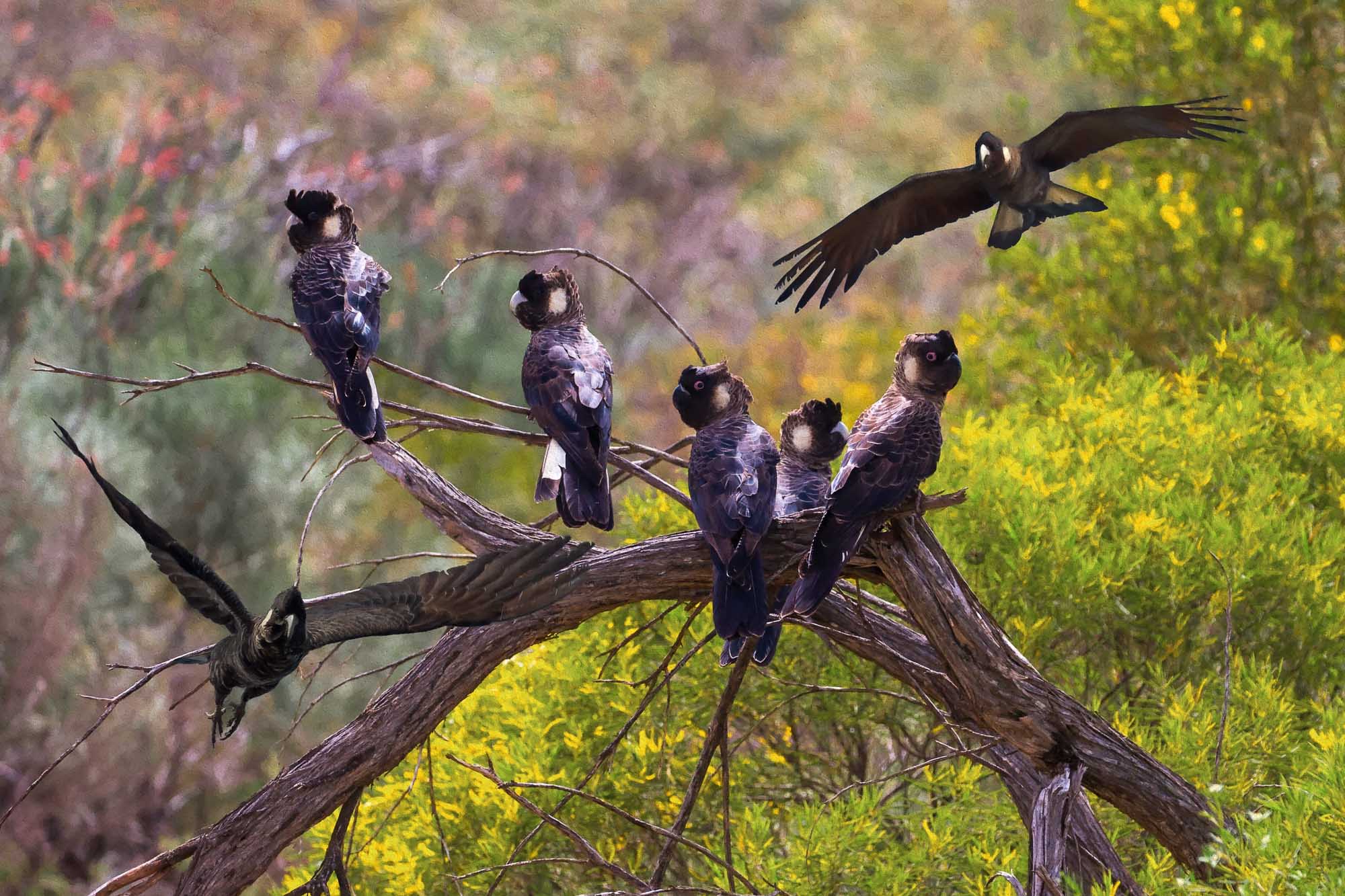
Most parrots are specialist seed-eaters that tear apart seedpods, pine cones and nuts as well as eating grass seeds and young shoots; however, some, particularly lorikeets, also consume nectar and pollen. Although most parrots remain largely herbivorous, some supplement a diet of seeds and nuts with insects and their larvae, which are often prised from beneath the bark. Many subtropical and tropical species also eat fruit such as bananas, rainforest fruit and native figs. Among seedeaters, competition is usually low as species of seed-bearing plants often produce their bounty at the same time each year, making food plentiful even when an entire flock is foraging together. Cockatoos especially benefit from a flock social structure. They cleverly post a sentry in a nearby tree to watch over the flock and alert them to danger.
Above and below: listed as a threatened species, the Carnaby’s black cockatoo form both small and large flocks and part of a massive flock of budgerigars visits a waterhole after a long day feeding on grass seeds on the plains of western Queensland.


Busy with feathers
Feathers become brittle and tatty over time, despite constant preening, so parrots and cockatoos must still moult and regrow their feathers at least once a year. The primary wing feathers are shed sequentially from the middle of the wing outwards to the tip, to allow the birds to continue to fly for as long as possible while moulting. Preening, or running the beak along the shaft of the feather, enables the bird to “zip” into place the barbules that make up the vanes of the feather. Parrots also have powder-down feathers whose tips, when preened, break down into flakes of keratin. This powder coats the other feathers and keeps them sleek.
A sulphur-created cockatoo busies itself with feather preening.


The Parrot Life Cycle
Most parrots and cockatoos pair for life and renew their attraction with mutual preening and “courtship feeding” — whereby the male offers his partner gifts of food during the breeding season. Strong pair bonds are a defining trait of these birds, with many species—including galahs, sulphur-crested cockatoos, rainbow lorikeets, and eclectus parrots—forming lifelong partnerships. These devoted pairs share responsibilities such as nest building, incubation, and feeding their chicks, and they maintain close social ties through mutual grooming and feeding even outside the breeding season. When attracting a female, male parrots may swivel their heads, pirouette, preen the female, and gently nibble at her head and beak. Male cockatoos frequently bob their heads up and down and raise and lower their crests in display. Spring is the preferred breeding time for many species, with one to six eggs laid on consecutive days, depending on the species. Some parrots delay incubation until all eggs are laid, so the chicks hatch simultaneously, while others begin incubating immediately, resulting in staggered hatching. Nests are typically situated deep in tree hollows, lined with eucalypt bark, gum leaves, or chewed twigs for insulation and protection. Notable exceptions are the ground-dwelling species, such as the Night Parrot, Ground Parrot, and Rock Parrot—the latter eschewing traditional nests altogether, laying its eggs in shallow depressions on rocky ledges or coastal cliff-faces.
Above, left and right: Yellow-tailed black cockatoos mutually preening and a male king parrot feeding its young.


Above left to right: Rainbow lorikeet and male Eclectus parrot both favour tree hollows as nesting sites.
Bird nurseries
Studies have shown that eggs laid in tree hollows and cavities are statistically safer than those laid in stick nests; however, a tree hollow home has its own disadvantages. Hollows can be extremely hard to come by. Most parrots use the same hollow year after year and are extremely territorial. Because hollows usually only form in large, old trees, competition for nest spaces is tight. Unfortunately, deforestation and land clearing have reduced the availability of avian nest sites. Some species, such as white cockatoos, usually share incubation of the eggs, which takes about 30 days, but in black-cockatoo species only the female incubates the eggs. While the female broods the eggs in the hollow, her partner brings her food.
All parrots lay white, only slightly oblong eggs. Because many parrots nest in tree hollows, their eggs are hidden from view and do not require speckling for camouflage. In the darkness of the hollow, the white eggs are also easier for the parents to see. Because nests in tree hollows are snug and secure, parrots’ eggs do not need to be oval-shaped as they are unable to roll out of the nest anyway. When the chicks hatch, they are blind and mostly featherless. Feathers usually start to grow at around four weeks, but are frequently paler than the adults’ plumage and remain sheathed for some time. Most chicks stay in the nest for 5–6 weeks. However, hatchlings of some species remain dependent on their parents for a further 4–6 weeks after leaving the nest and may be left in a “creche” with other juveniles while the parents seek food. Once independent, juvenile birds often form wandering flocks until they form a pair bond.


Above: Triggered by favourable food supplies budgerigars may form flocks in tens of thousands a sight that is most exciting to say the least.
Seeing Parrots in the wild
Australia’s geographical isolation has allowed its parrot species to diversify across this vast continent with little competition from other large, herbivorous birds. Consequently, parrots are often seen in almost all Australian habitats, from the dry, seasonally grassy inland to the coast. Despite their bright plumage, many species are remarkably well-camouflaged in their chosen habitats, with only a flash of underwing vibrance to give them away. Only two species, the Ground Parrot and the Night Parrot, have evolved to favour a terrestrial lifestyle. Others, such as the Mulga Parrot and Rock Parrot, show a preference for specific habitats (Mulga woodlands and harsh saline dunes respectively). Rainforest species include the spectacularly large Palm Cockatoo and brilliantly coloured, sexually dimorphic Eclectus Parrot. Parrots seldom migrate, although some follow the flowering of plants which, by their feeding, they pollinate. One of the most widespread species is the Galah, which ranges across the entire mainland and Tasmania. Rosellas, which have genetically distinct representatives in each Australian State, are also extremely abundant and commonly encountered members of the parrot family.

Images top row left to right: Pale-headed Rosella; Red-winged parrot; Australian ringneck parrot (WA race) and male King Parrot.
Images second row: Swift parrot; Elegant parrot; Paradise Parrot and Orange-bellied Parrot.
Cockatoos – Family: Cacatuidae
Cockatoos are not unique to Australia. New Guinea, the Philippines and Indonesia also have cockatoos, but they remain more abundant on this continent, with fourteen native species, than anywhere else in the world. A feature that sets cockatoos apart from other parrots is the movable crest. Although generally not as brightly plumed as other parrots, cockatoos reserve much of their colour for this perky tuft, which varies in size and colour from species to species and is raised or lowered as a form of communication. The smallest cockatoo, the Cockatiel, has a brilliantly plumed, pale yellow crest. The largest species is the Palm Cockatoo, which occupies tropical northern rainforest and woodlands on Cape York Peninsula. Most other cockatoos are considered birds of the forests and woodlands. Only three cockatoo species, the Galah, Gang-Gang and Major Mitchell’s Cockatoo, have plumage that almost rivals the Psittacidae parrots, with hues of pink, grey and rosy red. Most other species can loosely be considered either a black or white species. Black-Cockatoos consist of five species in the genus Calyptorhynchus, which translates as “hidden beak” — a reference to the habit of some species of fluffing up their cheek feathers to cover part of the beak. All have mostly black plumage that differs between the sexes of each species to include either cheek patches, coloured undertail coverts or body speckling. White cockatoos include the Sulphur-crested Cockatoo and three corella species, all of which are similarly attired in white plumage with blushes of colour on the face, or crest, and underwing and undertail coverts.
Cockatoos enjoy remarkable longevity. Captive birds can live for more than 50 years, but even in the wild some have a similar lifespan to humans. The oldest recorded cockatoo was a Little Corella that was tagged in 1901. It was found dead on the roadside in 1972 — making it 71 years old.


Images top row left to right: Pale-headed Rosella; Red-winged parrot; Australian ringneck parrot (WA race) and male King Parrot.
Images second row: Swift parrot; Elegant parrot; Princess Parrot and Orange-bellied Parrot.
Parrots – Family: Psittacidae
Parrots in the Psittacidae family are commonly referred to as the “typical” parrots — although their wide distribution and range of fabulously varied colours make them anything but typical. For the purpose of discussing Australian species, the family can be divided into two basic subfamilies — the Psittacinae ( parrots, parakeets and fig-parrots all separated into distinct genera ) and the Loriinae ( lorikeets ). Like all other Psittaciformes, they have zygodactylous toes, curved bills and powder-down feathers.
For the most part, the males are the more brightly attired of these parrots; however, the Eclectus Parrot is a notable exception. Colour variations probably evolved for two reasons: firstly to distinguish species with overlapping ranges, and secondly to make the birds either distinctive ( to attract a mate ) or camouflaged within their habitat. Red and yellow feather colours form from carotenes, the same pigments that colour carrots. Black feathers are the result of melatonin, which also colours human skin. Blue feathers appear blue due to Tindall scattering — when feathers reflect and absorb only some of the wavelengths in white light — the same effect that makes the sky appear blue. Along with a kaleidoscope of wonderful colours, some parrots also use fluorescence to help them attract a mate; studies show that certain feathers glow under ultraviolet ( UV ) light. These cryptic mating codes would not attract the attention of mammalian predators, which cannot see UV light.
Being smaller, swifter and more abundant than the larger cockatoos, parrots inhabit a greater diversity of vegetation types. Some ornithologists group species based on their habitats or relatives: six small species in the genus Neophema are called the “grass parrots”, rosella species form a group, and so do the so-called “magnificent parrots” in the Polytelis genus. None of these groups diverge from the “typical parrot” characteristics as much as the lorikeets do.

Images left to right: Varied lorikeet; Scaly-breasted lorikeet; Little lorikeet and Rainbow lorikeet.
Lorikeets – Sub-family: Loriinae
Lorikeets in the subfamily Loriinae comprise about 55 worldwide species. New Guinea is a major hotspot for lorikeet species. Australia, in contrast, has just six species of these vibrant birds, although the jury is still out as to whether the Red-collared Lorikeet ( considered here as the rubritorquis race of the Rainbow Lorikeet ) is a seventh species.
All lorikeets possess one special adaptation that makes them particularly suited for a diet of nectar — an absorbent “brush-tipped” tongue covered in fine, spongy protrusions that soak up nectar. This feature makes lorikeets especially crucial for the environment — as moving pollinators of dependent plant species. Lorikeets do not rely exclusively on nectar, but supplement their diet with fruit, seeds and insects. Unlike many other parrot species, males and females are almost identical and difficult to sex by sight alone. Even juvenile birds are very similar in colour to adults. Nevertheless, locating and discerning the opposite sex from other birds in the flock does not appear to be problematic for the lorikeets themselves.
Australia’s species are distributed across much of the coast and hinterland of the continent, with the exception of a small pocket on the central coast of Western Australia. Flocks of lorikeets rarely go unnoticed, thanks in part to their kaleidoscopic colour, but also because they form extremely noisy groups that constantly chatter and squawk at each other. Some of Australia’s best-known, most commonly seen bird species belong to the lorikeet family, including the ubiquitous Rainbow Lorikeet that so delights campers and picnickers.

The Rainbow Lorikeet is one of the most magnificent and engaging of all the continent’s bird species. They are bold but welcome visitors to parks, backyards and campsites, where they descend in small, noisy flocks to be fed. Combined, two subspecies — moluccanus and the hotly disputed rubritorquis ( which some consider a separate species ) — inhabit coastal and hinterland regions from South Australia around to Cape York and the Top End. Another race, caeruleiceps lives on the Torres Strait island of Saibai.

People and parrots
Most people are delighted when they encounter parrots flying free in their natural environment; however, most of the interaction between people and these spectacular birds occur in backyards, camping grounds, suburban parks or aviaries. Many parrot species appear almost unafraid of humans and can become quite tame around places where humans and birds cohabit. Because they are flocking birds, it is not unusual for campers to be besieged by scores of chattering lorikeets alighting on their heads and outstretched arms at campsites. Although parrots can easily be enticed to take food from humans or visit a backyard bird-feeder, it is important to ensure that, firstly, the food being given is appropriate and, secondly, that only small amounts are given so that the birds do not become reliant on humans for food. Giving parrots the wrong kind of food can damage their beaks and affect their health. A better way to attract parrots, particularly lorikeets, is to plant a native garden using seed-bearing or nectar-producing plants. Birdbaths also attract some species, such as gregarious Rainbow Lorikeets and Crimson Rosellas.
Thank you. Your photos are beautiful. I had a most dekightful “Chatterbox” a King Parrot who visited every day for a chat and would come inside to check out my place too. But my very favorite was a grey and red rosella (?). It was just beautiful. Sooooo miss my home in Upewy Victoria 🙂
Thanks for sharing. Know the feeling. When we lived in the outer suburbs of Brisbane we had a family of Cockatoos visit us daily…still miss them. We still have cockatoos of several species, however the block is bigger and wilder so we don’t the the same intimate relationship.
Enchantment!!
Wow!!
Thank You!!
Thanks, Cynthia, irresistible creatures.
This has explained a lot of things about the cockatoos and parrots in my backyard, thank you.
It has good info
I agree